
PIETER VAN ROESTRAETEN (1630-1700)
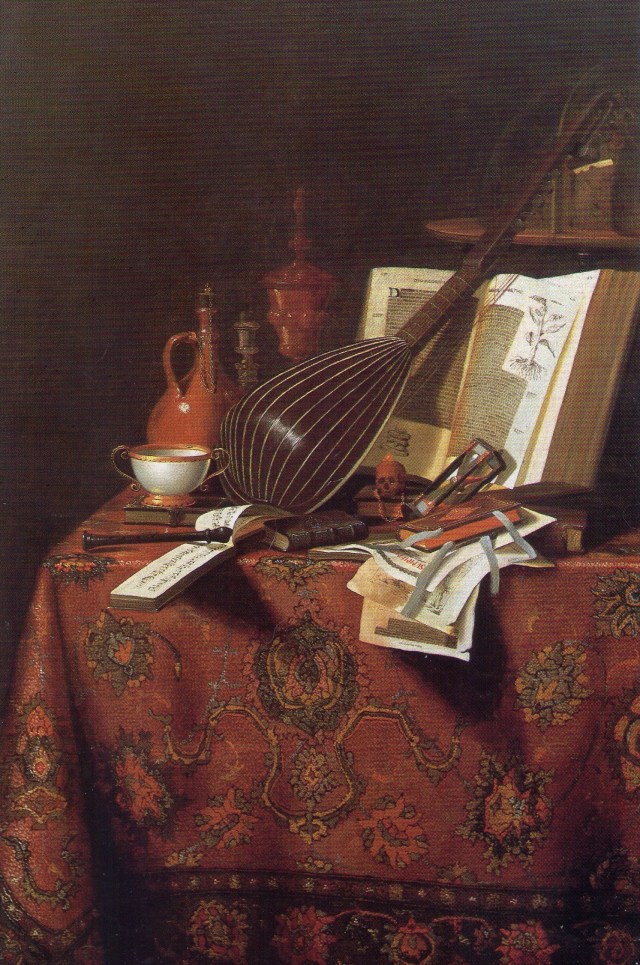
Vanitas Still-Life
Oil on canvas (146 x 97 cm)
Private collection
To enlarge the picture, right-click on it and “Open in a new tab”
Van Roestraeten was the son-in-law, as well as the pupil, of Frans Hals with whom he studied from 1646 to 1651. He started painting burlesque genre scenes, (The Proposition, Haarlem, Frans Hals Museum) sometimes with a moralizing message in the style of Jan Steen. Around 1662 he and his wife moved to England where he made the acquaintance of Lely who befriended him. He later started to paint portraits and still lives; in the latter, he displayed such a skill, particularly in the depiction of porcelain and silver, that Sir Peter Lely recommended him to dedicate to such a genre. Could it also be that by doing so Sir Peter avoided having a serious competitor as a portrait painter? Eventually, van Roestraeten followed Lely’s advice and became very popular among the English aristocracy charging £50 per painting. He was seriously injured during the Great Fire of London (1666) resulting in a pronounced limp. He died in London in 1700
In the 17th century, it was fashionable to include in still-life reminders of man’s mortality and the supposed futility (according to fanatical, pleasure and joy-hating Christians, particularly Protestants) of his quest for pleasure or knowledge. Catholics and Protestants alike were keen on these images that reminded man of the need to lead a life according to the precepts of the Church. This specific genre took the name of Vanitas and some artists, like van Roestraeten, specialized in them.
This painting includes the classical and more popular items in the Vanitas genre: the skull and the hourglass, the former a reminder of our mortality and the latter of the implacable passing of the years. Instead of the usual flowers or fruits that also represent the passing of time and physical decay, there is a book about plants, this is also a reflection about the senseless pursuit of knowledge, a knowledge that will die with us. The instrument, a theorbo (a kind of lute), represents worldly pleasures, as well as the bottle of wine. Van Roestraeten represents every item with care and skill. The beautiful Turkish rug allows him to show not only his virtuosity but also his fine sense of colour, a delicate combination of reds, browns and golden hues.
 Old Masters