
NICOLAS DE LARGILLIERE (1656-1746)
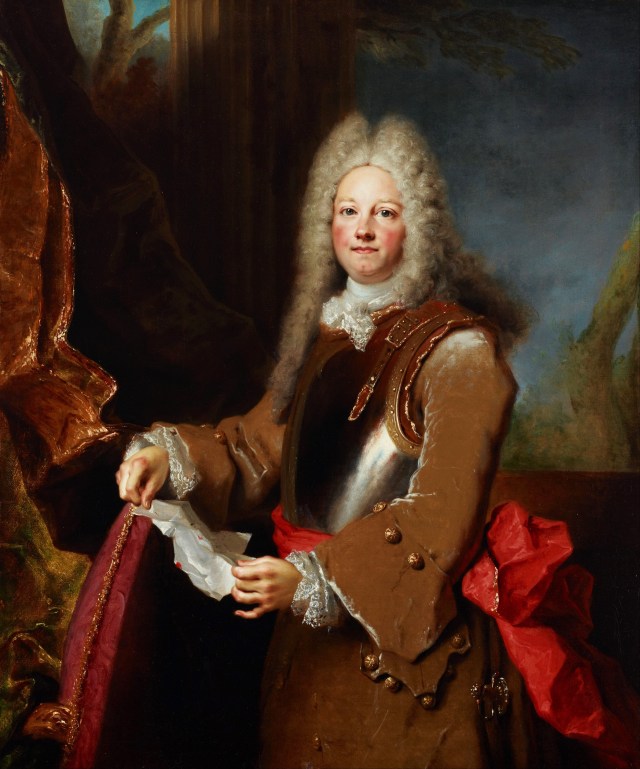
Portrait of an Officier, c. 1715
Oil on canvas (66 x 55 cm)
Art Gallery of New South Wales, Sydney, Australia
To enlarge the picture, right-click on it and “Open in a new tab”
Unjustly neglected by art historians, particularly the Anglo-Americans, in favour of his contemporary and rival Hyacinthe Rigaud (1659-1743), Nicolas de Largillière was the other great master of portraiture during the period known in France as Le Grand Siècle that covers the reign of Louis XIV (1660-1715), although many French historians disagree with such narrow-minded concept. Whereas Rigaud was the favourite of the Court and the aristocracy Largillière was the painter of the high-ranking civil servants, intellectuals and the beau monde of Paris. Like Rubens, he excelled at everything he did; portraits, landscapes, still lives, etc. His Flemish artistic education gave him that rich sense of colour typical of Rubens and his school. After a brief stay in London, where he was offered a position by Charles II who was marvelled by the youngster’s talent, Largillière returned to France where he would find fame and glory. After a nearly sixty-year-long career, he died at 89 leaving behind nearly 1.500 paintings.
The identity of the sitter is unknown as well as the year in which the portrait was painted, although it has been dated around 1715, by that time the reforms by Louvois, Louis XIV’s Minister of War, had succeeded in standardising the uniforms of the French army; white or grey for the French units, except the Maison du Roi, an elite corps that constituted a virtual Royal Guard, and red for the foreign regiments. The man portrayed here seems to be a general as he is wearing a special uniform. Largillière has chosen to depict him in an elegant setting, befitting his high rank, with rich draperies on the left and a column behind giving the otherwise small-scale painting a monumental grandeur. In his exquisitely painted hands, he is holding a report and looks at the viewer with a steady gaze that reflects serenity and self-control. Largillière’s virtuosity is evident everywhere; in the delicate sfumato of the wig, in the beautifully rendered velvet of the coat, the shimmering silk of the sash and the shine of the cuirass. When one looks at this masterpiece of baroque painting the fact that Largillière is almost unknown outside the small circle of academics specialized in French 17th-century painting and lovers of it, becomes even more puzzling.
 Old Masters