
FRANCESCO ZUCCARELLI (1702-1788)
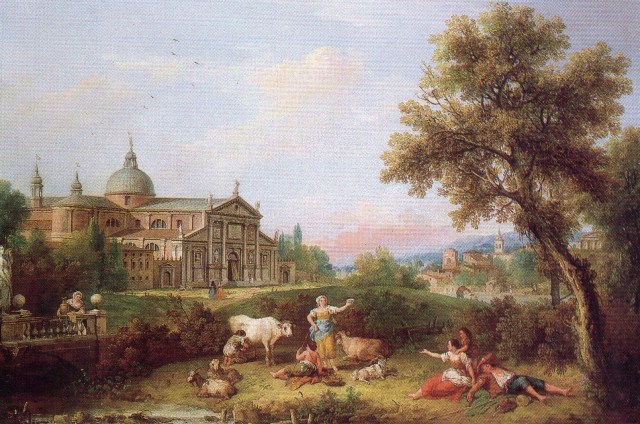
Capriccio with San Giorgio Maggiore
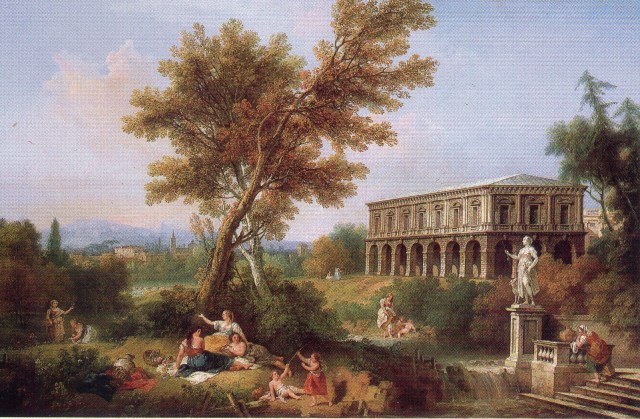
Capriccio with the Prison from the Riva Schiavone
Oil on canvas (86 x 128 cm)
Private collection
Zuccarelli is considered the most important landscape painter to have emerged from his adoptive city of Venice during the first half of the XVIIIth century. Born in Pitigliano, he spent his early years in Rome where he trained under Giovanni Maria Morandi, a portrait painter. In 1725 he returned to Pitigliano where he received his first commission: a pair of altarpieces. After spending five years in Florence, where he began to paint landscapes, Zuccarelli moved to Venice in 1732. He developed a particular style of landscapes which combined the luminous atmosphere of the Roman school with the vibrant colours of the Venetian painting. He became a much sought-after artist and enjoyed early patronage particularly from Joseph Smith the British consul in Venice and a prominent art collector and dealer. In 1752 he departed for England carrying with him introductory letters from Smith; his stay there was extremely profitable, thanks to his fine manners and gentle disposition he was very popular. He painted landscapes, historical scenes and designed tapestries. In 1763 he was back in Venice where he became a member of the Academy. He returned to England in 1765 where he was lauded by the nobility and the critics. In 1768 he became a founding member of the Royal Academy of Arts. Back in Italy in 1771 he was appointed President of the Venetian Academy; he resigned a few years later and moved to Florence where he died aged 86.
The first painting shows the church of San Giorgio Maggiore (St. George the Great) the Benedictine basilica designed by Palladio and built between 1566 and 1610. The view is an imaginary one since the church and the monastery are built on the waterfront. This is the view from the lagoon; instead, a vast expanse of water Zuccarelli shows us milkmaids at work and peasants at rest in an Arcadian landscape of bright blue skies.
This is another capriccio (imaginary landscape) that show us the Palazzo delle Prigioni (the Prison) built between 1589 and 1614. The building was also the seat of the Magistratura dei Signori di Note an institution in charge of prosecuting common criminals and their surveillance. This new building was joined to the Palazzo Ducale by the Bridge of Sighs built in 1614. Here Zuccarelli shows us the prison building standing in isolation in a beautiful park where peasants pic-nic while others wash their clothes.
 Old Masters