
GUIDO RENI (1575-1642)
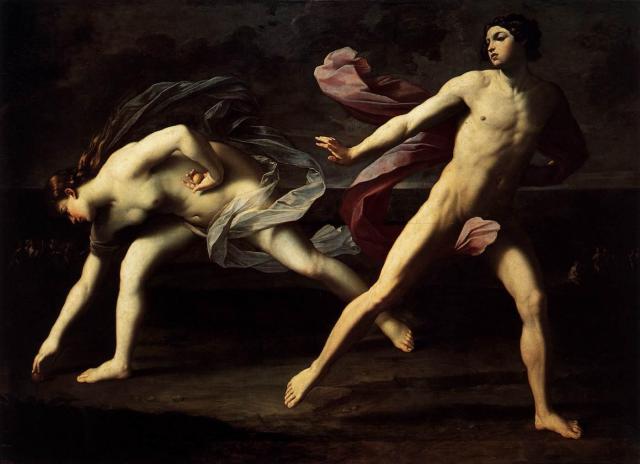
Atalanta and Hippomenes (1622-25)
Museo del Prado, Madrid
Oil on canvas (206 x 297 cm)
To enlarge the picture, right-click on it and “Open in a new tab”
Born in Bologna Guido Reni was apprenticed at the age of 10 to the Flemish master Denis Calvaert, after a few years he joined the prestigious Accademia Degli Incamminanti (1) directed by Ludovico Carracci. It was there that Reni developed his elegant, restrained, classicism that rejects the dramatic Baroque style of his contemporaries. In 1601 he moved to Rome where he was employed by the great families to decorate their palaces He returned to Bologna in 1614 establishing there a prolific studio. He frescoed the Basilica of St. Domenico and painted numerous altarpieces. After leaving Rome Reni experimented with different styles, ranging from bright, vibrant colours to tenebrist compositions that betray the influence of Caravaggio. Reni’s subjects were mainly religious or mythological, he painted few portraits, the most noteworthy being the one of his mother (Pinacoteca di Bologna) In spite of his popularity Reni was frequently in financial problems due to his gambling addiction, which resulted in numerous copies by his workshop and unfinished commissions.
Atalanta was a young virgin huntress, a favourite of Diana. It was Atalanta who had wounded the famous Calydonian boar which resulted in the beast’s ultimate death. After consulting the gods about her future she was warned never to marry; acting upon this warning she rejected all the suitors who came to ask for her hand. Her father begged her to change her ways and she accepted but with the condition that she would only marry the man who could defeat her in a race. Several tried and lost until the young Hippomenes came in. He had asked Venus, the goddess of Love, for help and she gave him three golden apples that he would drop during the race. He did so, slowing down Atalanata who stopped to pick them up, winning the race and Atalanta’s hand.
Atalanta and Hippomenes went on a journey and they stopped at a temple consecrated to the goddess Cybele where they made love, profaning the temple and offending the goddess who turned them into lions, and so the oracle was fulfilled.
This beautiful painting is one example of Reni’s use of the chiaroscuro (2) borrowed from Caravaggio. The bodies shine against the dark background, in the case of Hippomenes we can see clearly the kind of idealized body that Reni favoured. The drapery around their bodies covers their private parts in a natural, graceful manner. The composition is based on two diagonals formed by the bodies that complement each other. As strange as it seems this beautiful painting escaped destruction by a narrow margin. In 1772 it was taken away and sent, with other paintings considered obscene by Charles III, to the studio of the King’s Court Painter, they were to be burned but, luckily, the royal order never came and in 1796 were sent to the Academia de San Fernando (The Royal Academy of Fine Arts, created in 1752). They finally returned to El Prado in 1827.
(1) Literally “Academy of the Walkers” in the sense of walking/travelling towards perfection. It was an art academy founded in 1590 in Bologna by the Carracci brothers (Agostino, Ludovico and Annibale) Considered the first major art school based on life drawing, the Academy was the model for later art schools throughout Europe
(2) In Italian “light-dark”, an expression used to describe Caravaggio’s technique of placing brightly illuminated bodies against a very dark backgound.
 Old Masters