
LUISA IGNACIA ROLDÁN (1652-1706)
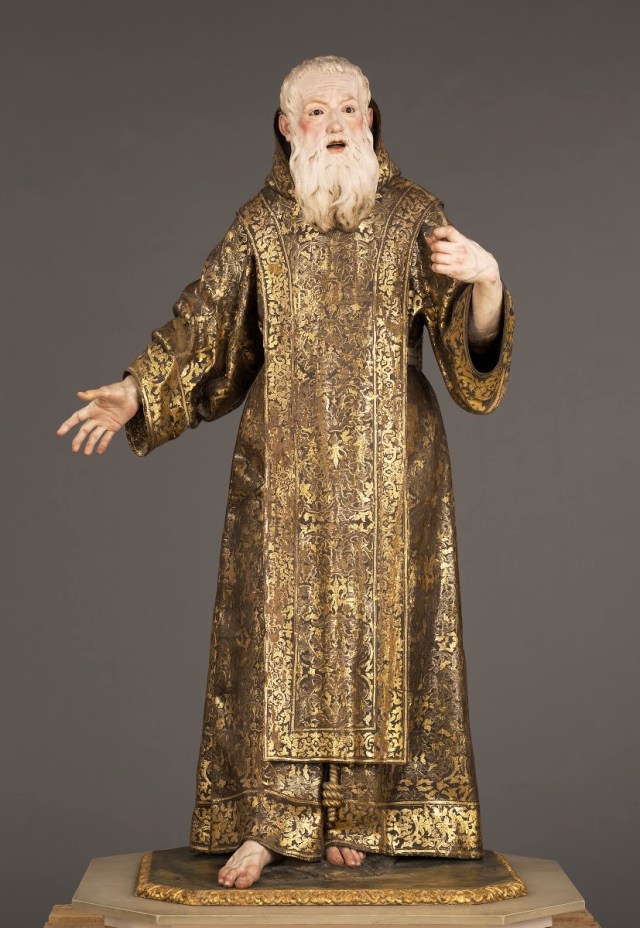
San Ginés de La Jara (1692)
Wood, painted and gilded. Height: 176 cm
Paul J. Getty Museum, Los Angeles
To enlarge the picture, right-click on it and open it on a new tab
Luisa Roldán (better known as La Roldana) was the first Spanish female sculptor on record and one of the finest practitioners of this art in Spain during the second half of the XVIIth century. She was schooled by her father, a fine sculptor and director of an important workshop. Her sisters María and Francisca were also artists, the former was a sculptress like Luisa and the latter a painter. Her skill became apparent very early and her father entrusted her with important commissions. She was particularly famous for her beautiful images of the Virgin; they were life-size and painted for greater realism, sometimes they were dressed in very fine garments richly embroidered in gold and silver for solemn processions.
This sculpture represents the challenge imposed on the artists by the Church authorities. According to the principles regarding the representation of Jesus, his mother and the saints, these must be extremely realistic to impress upon the masses the extent of the sufferings of Jesus and the saints. The Council of Trent made clear the images must provide a stimulus to piety and that could only be achieved by a realistic depiction.
San Ginés is represented as if he was surprised by a vision, his face and his body in a state of wonder. To achieve a hyper-realistic depiction of the saint’s eyes were made of glass. His rich garments, heavily embroidered with gold, are the product of a technique known as estofado: the gold leaf is applied according to a pattern, and then covered with a brown pigment. The pigment is later scrubbed to reveal the gold leaf giving the impression of genuine gold brocade.
Several legends tell the story of San Ginés, a member of the French royal family (hence the Fleur de Lys, the emblem of the Kings of France on the saint’s robe) who became revered as a saint in Spain. The most popular story tells that, as he was on a pilgrimage to Santiago de Compostela, Ginés became a victim of a shipwreck; he made it to the coast and decided to build a cabin and live there as a hermit, at his death the members of the Order of Saint Francis built a convent there and dedicated it to San Ginés.
 Old Masters