
ROMBOUT VERHULST (1624-1698)
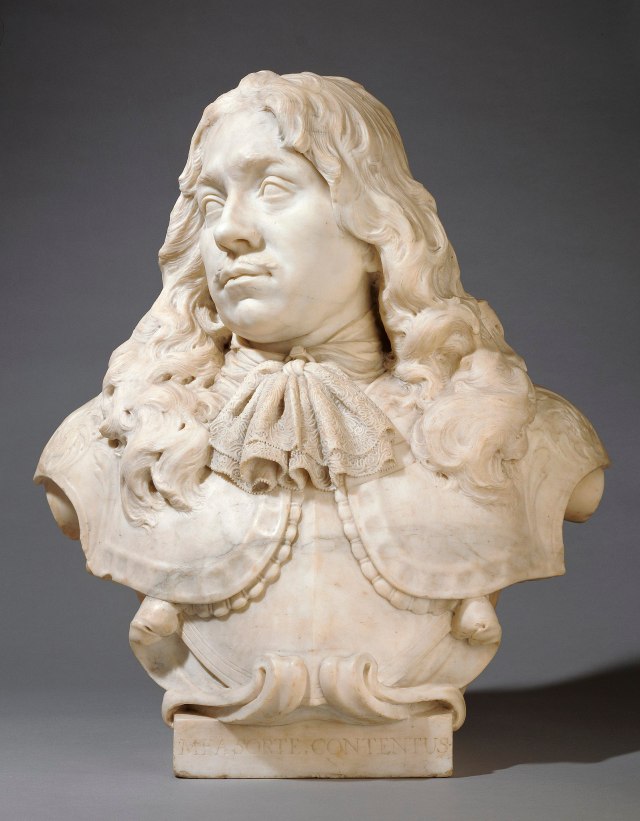
Bust of Jacob van Reygersberg (1671)
Marble: Height: 63 cm – Width: 57 – Depth: 33 cm
Paul J. Getty Museum, Los Angeles
To enlarge the picture, right-click on it and “Open in a new tab”
Rombout Verhulst was one of the finest Flemish sculptors of the XVIIth century. Born in Malines, he moved to Amsterdam where he arrived in 1646. He worked with the great local sculptor Artus Quellinus in the decoration of the new Town Hall. The sculptural decorations in the Amsterdam city hall established the international reputation of Quellinus and his workshop and would lead to many more foreign commissions for the Quellinus workshop including in Germany, Denmark and England. Verhulst´s skill was already noticed and he was the only sculptor involved in the project to sign his own works. After Quellinus’s departure to Antwerp, Verhulst became the most important sculptor in the Netherlands.
During the 1660s Verhulst was able to rely on a network of private patrons in which the van Reygersberg family played a vital role. In 1663 he completed a funeral monument for Maria van Reygersberg in the church of Katwijk Binnen. This was the first private commission for a work of this type in the first half of the XVIIth century His patronage shifted gradually from Amsterdam to The Hague.
Verhulst is mainly remembered for his many tomb monuments for private and public patrons. His funeral monument for Maria van Reygersberg established his reputation in this field with his lively, realistic style. He made many monuments erected to commemorate Dutch naval heroes. His most important work in this area is the monument to the Dutch national hero Michiel de Ruyter in the Nieuwe Kerk in Amsterdam. In addition to the monumental commissions he completed, Verhulst made small-scale ivory carvings, a speciality for which his home town Mechelen was particularly known. A small ivory Virgin and Child held in the Rijksmuseum shows his skill in this regard. He has carved the thick, wavy locks of hair of the chubby Christ Child and the heavy drapery with such realism that they appear almost tangible.
Jacob van Reygersberg (1625-1675) was MP for the province of Zeeland and director of the Navy ministry as well as the owner of the manors of Couwerve and Crabbedijke. When Verhulst executed this bust van Reygersberg was 46 years old and was at the summit of his political career. The independent busts were something rare in the Netherlands, they were usually commissioned by the members of the regency of Amsterdam or by the court at The Hague.
Jacob was the son of Johan van Reygersberg, a lawyer and high-ranking civil servant in the province of Zeeland. I could not find evidence about Jacob´s studies but in the 1650s he married Maria van Gheel, a girl from a wealthy patrician family in Amsterdam and in September 1663 he was sent to the States General (the Dutch Parliament) in The Hague as representative of the province of Zeeland. He was a wealthy man who not only owned the manors of Couwerve and Crabbedijke but also the castle of Westhove in Zeeland and the country estate of Fontaynenburg near The Hague.
The bust of Jacob van Reygersberg shows Verhulst’s consummate skill at an advantage. He has not idealized his sitter, the portrait is realistic and it differentiates the textures of the hair, the armour, and the lace cravat. To avoid the impression created by the abrupt horizontal break at the chest Verhulst developed an ingenious technique: he made use of the rounded plates of armour that protect the shoulders and the upper chest and emphasised their outlines leading up to the face of the sitter.
 Old Masters