
CLAUDE-JOSEPH VERNET (1714-1789)
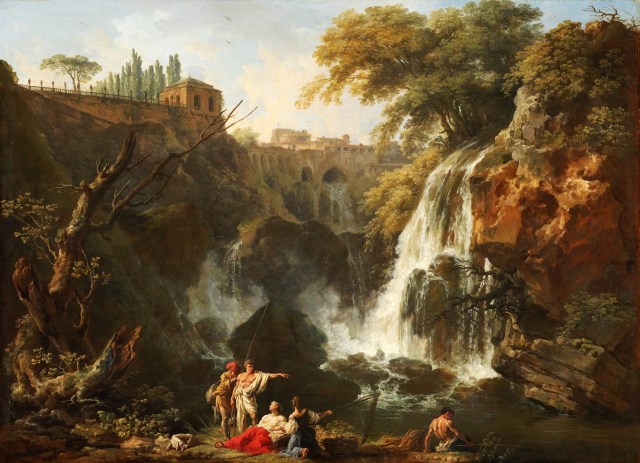
The Waterfalls near Tivoli and the Villa of Maecenas
Oil on canvas 101 x 138 cm
Mauritshuis, The Hague
To enlarge the picture, right-click on it and “Open in a new tab”
The painting was described in the sale catalogue of 1763 as a view near the town of Narni and was later thought to be a scene of the waterfalls near Tivoli with the villa of Maecenas in the background. In fact, however, it is probably an imaginary scene like the Italian harbour in stormy weather.
We see a group of Arcadian figures in the foreground, either fishing or passing the time of the day. The town in the distance has fortifications and that lends a heroic air to the landscape. The waterfalls near Tivoli have always been regarded as a pendant of the Italian harbour and it was very probably intended as such. Most of the landscapes and the maritime views of Vernet are imaginary scenes which bear only a remote resemblance to recognizable places.
Gaius Cilinius Maecenas was a friend and political advisor to Octavian, who was to become the first Roman emperor as Cesar Augustus. In spite of his great wealth and influence, he did not enter into politics preferring the role of a generous patron of the arts. His patronage was exercised not from vanity or a mere dilettante love of letters, but with a view to the higher interest of the State He recognized in the genius of the poets of that time not only the truest ornament of the court but the power of reconciling men’s minds to the new order of things and of investing the actual state of affairs with an ideal glory and majesty. His name has become a byword for a wealthy, generous and enlightened patron of the arts.
Vernet’s painting is a tribute to the golden age of Roman civilization when poets, artists and men of power shared an idea that was reflected in the beautiful villas, the imposing public buildings and the superb sculptures that reflected the greatness of Rome.
 Old Masters