
ADELAIDE LABILLE-GUIARD (1749-1803)
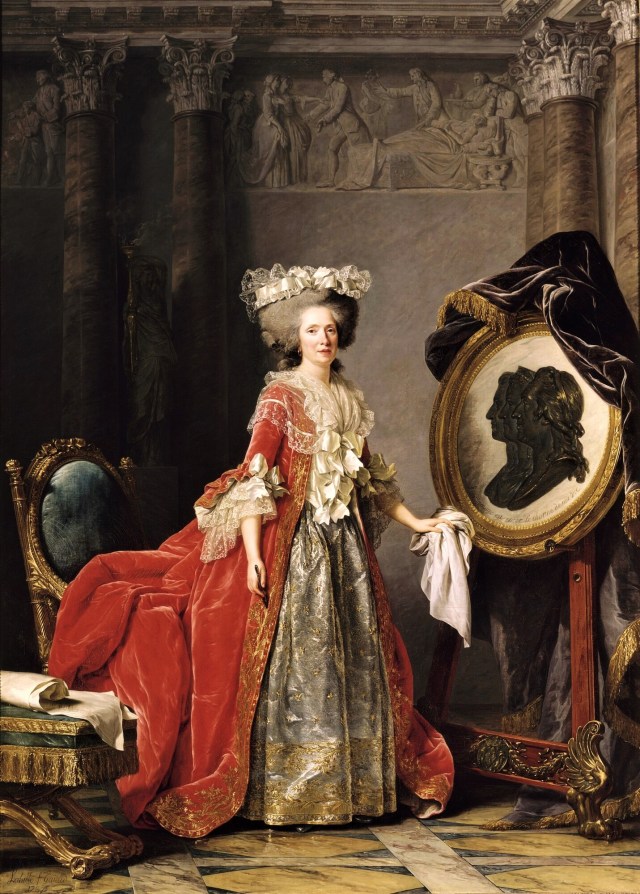
Portrait of Madame Adelaide de France (1787)
Oil on canvas 271 x 194 cm
Chateau de Versailles
To enlarge the image, right-click on it and “Open in a new tab”
Adélaide Labille was born in Paris, the youngest of eight children. Her father was a haberdasher who owned a shop named A la Toilette; by a curious coincidence, the future Madame du Barry worked in that same shop when she was eighteen and became friends with Adelaide.
During adolescence, Labille studied miniature painting with Francois-Elie Vincent, a family friend. Vincent’s connections enabled her to exhibit her works at the Academie de Saint Luc, the painter’s guild. During this apprenticeship, she would meet her future husband François-André Vincent.
In 1769 she married Nicolas Guiard, a civil servant; the marriage contract acknowledged Labille-Guiard as a professional painter at the Academie de Saint Luc. The couple separated in 1777; after the Revolutionary legislation permitted they divorced in 1793 but Adelaide kept the surname Guiard and became known as Labille-Guiard. Her talent as an oil painter and a pastellist was noticed and the critics praised her works exhibited at the Salon de la Correspondance.
Adelaide Labille-Guiard enjoyed an excellent relationship with the royal family, particularly with the sisters of Louis XV, Adelaide and Victoire. It was Mme. Adelaide who obtained a pension of 1,000 livres for the artist and lodgings in the château of Versailles.
Princess Adelaide was never married. In the late 1740’s when she had reached the age when princesses usually married, there were no potential Catholic consorts of desired status available. She preferred to remain single rather than marry someone below the status of a monarch or an heir to a throne. Adelaide was described as an intelligent beauty, she spoke fluently Italian and was a skilful musical performer. Unfortunately, she was very arrogant and possessed a dominant and ambitious character. A lady member of the Court described her thus: “Madame Adelaide had more mind than Madame Victoire, but she was altogether deficient in that kindness which alone creates affection for the great, she had abrupt manners, a harsh voice and a short way of speaking that rendered her more than imposing. She carried the idea of the prerogative of rank to a high pitch” (1) (Mme. Campan, “Memoirs of the Court of Marie-Antoinette, Queen of France“)
At the beginning of his reign, the confidence Louis XVI had for his aunt sometimes extended to State affairs and he thought her intelligent enough to make her his political adviser and allow her to make appointments to the Treasury; a revealing detail that tells you how unintelligent and politically clueless Louis XVI was. However, her political activity was opposed to such a degree to the king’s dispositions that he saw no other option than to exclude her from State affairs.
Madame Adelaide and her sisters did not get along well with Queen Marie-Antoinette. When the queen introduced the new custom of informal evening family suppers, as well as other habits that undermined the rigid old court etiquette, there was an exodus of the more recalcitrant members of the old nobility to the salon of the Mesdames, as the daughters of Louis XV were known. The Austrian ambassador wrote saying that their salon was a centre of intrigues against Marie-Antoinette where the Mesdames tolerated insulting poems addressed to the queen.
Mme. Adelaide and Mme. Victoire managed to escape the worst excesses of the French Revolution and settled in Rome in 1791, they remained there until the invasion of Italy by the French army in 1796. They fled to Naples where the sister of Marie-Antoinette, Maria Carolina, was queen. Both princesses died in exile.
The portrait shows Mme. Adelaide standing by an easel where there is a medallion representing her sisters. Her expression is placid and welcoming. Labille-Guiard has rendered faithfully and skilfully the shimmering silk of her skirt and the translucent fine lace that decorates her sleeves and shoulders. A very fine formal portrait of the late XVIIIth century.
(1) The Memoirs of Jeanne-Louise-Henriette Campan (1752-1822) are extremely important and valuable, since she was Première femme de Chambre (First lady of the Camber or First Lady-in-Waiting) of Marie Antoinette from 1786 to 1792. Anyone interested in the court of Louis XVI and/or Marie Antoinette should read them. There is an excellent version (edited by G.K. Fortescue, 1908) in English available in PDF on http://www.archive.org.
 Old Masters