
ADELAIDE LABILLE-GUIARD (1749-1803)
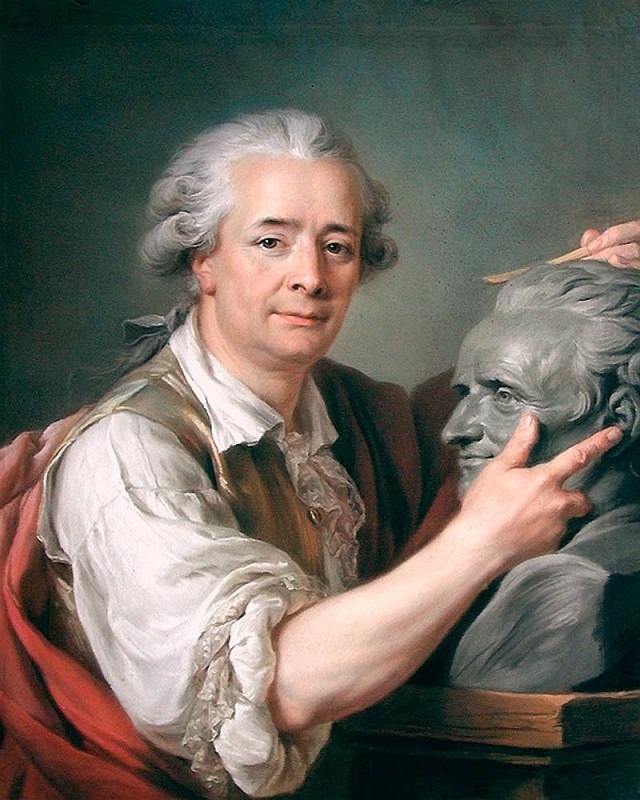
Portrait of the sculptor Augustin Pajou (1783)
Pastel on paper: 72 x 63 cm
Musée du Louvre
Adélaide Labille was born in Paris, the youngest of eight children. Her father was a haberdasher who owned a shop named A la Toilette; by a curious coincidence, the future Madame du Barry worked in that same shop when she was eighteen and became friends with Adelaide.
During adolescence, Labille studied miniature painting with Francois-Elie Vincent, a family friend. Vincent’s connections enabled her to exhibit her works at the Academie de Saint Luc, the painter’s guild. During this apprenticeship, she would meet her future husband François-André Vincent.
In 1769 she married Nicolas Guiard, a civil servant; the marriage contract acknowledged Labille-Guiard as a professional painter at the Academie de Saint Luc. The couple separated in 1777; after the Revolutionary legislation permitted they divorced in 1793 but Adelaide kept the surname Guiard and became known as Labille-Guiard. Her talent as an oil painter and a pastellist was noticed and the critics praised her works exhibited at the Salon de la Correspondance This institution allowed those artists who were not members of the Royal Academy to exhibit their works for a small fee. In February 1783 she presented the splendid Portrait of the sculptor Augustin Pajou which was highly praised. The famous and influential critic Pahin de La Blancherie wrote:
“We congratulate Mde Guyard on the confidence that such distinguished men have in her talents; it completely destroys the false opinion that envy or ignorance was eager to spread among the public, that the merit of his works was due to a foreign hand; we still hope for a new proof of the solidity of his talent, through the portrait of Mr. Pajou, represented modelling that of Mr. Lemoine. It remains for us to present to Mde Guyard the wishes of the public to produce a portrait of the famous Latour of whom she is a student and in whose footsteps she follows with so much success; we find more and more in his productions this expression and this truth which, carried to the highest point by his master, gives him the right to immortality.” (Quoted by Paul Ratouis de Limay in Le Pastel en France au XVIIIe siècle, p. 101)
Thanks to François-Andre Vincent who referred several of his friends in the Royal Academy to her for portraits, on 31 May 1783 Adelaide Labille-Guiard was accepted as a member of the Academie Royale de Peinture et Sculpture. Patronage by the aunt of Louis XVI, the Princess Marie Adelaide gained Labille-Guiard a pension of 1,000 livres and commissions to portray members of the Royal family. She enjoyed great success and her portraits were favourably compared to the ones by Vigée-Le Brun.
Her royal connections made her politically suspect after the French Revolution; she was forced to destroy several of her royal portraits but in 1791 she exhibited at the Salon portraits of several members of the National Assembly, including Robespierre. In 1799 she married her old friend François-André Vincent, after which she signed some of her paintings Mme. Vincent. She passed away in June 1803
This is one of Labille-Guiard’s finest portraits; you can tell there is a profound empathy between the sitter and the painter. Pajou (1730-1809) is shown working in one of his finest works: the bust of his teacher Jean-Baptiste Lemoyne (1704-1778); the final model, in bronze, is in the Louvre.
 Old Masters