
FRANCOIS-ANDRE VINCENT (1746-1816)
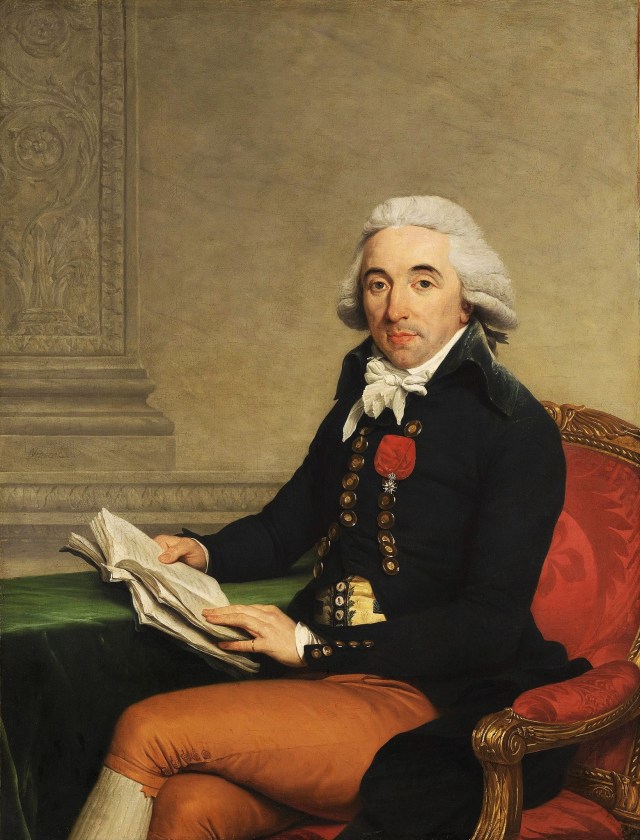
Portrait of a gentleman (maybe Monsieur Baillon)
Oil on canvas 117 x 89,5 cm
Rijksmuseum, Amsterdam
To enlarge the image, right-click on it and “Open in a new tab”
It gives me a great deal of pleasure to rescue a fine artist from oblivion. This is the case of François-André Vincent, who was highly esteemed by the connoisseurs and critics of his time and yet he has disappeared from art history books.
François-André Vincent had two excellent teachers; the first one was his father François-Elie Vincent, a miniature painter, and the second was Joseph-Marie Vien. François-André showed great aptitude and was rewarded with the prestigious Prix du Rome, a prize given to the outstanding young artist of the year. The prize consisted of a lengthy stay in Rome (in his case 1771-75) where the pupil would study the masters of the Renaissance and antique sculpture.
Upon his return from Rome, he was made a member of the Academie Royale de Peinture et Sculpture (1777) and as such he exhibited at the Salons (the yearly exhibitions of the Royal Academy). In 1794 he became a professor at the Ecole des Beaux-Arts; a few years later he was made a member of the Academie des Beaux-Arts de l’Institut de France, an institution that replaced the Royal Academy
In 1799 he married his pupil Adèlaide Labille-Guiard (1749-1803) a distinguished artist in her own right. Napoleon honoured him with the Legion of Honour, and between 1809 and 1815 he was a drawing professor at l’Ecole Polytechnique
Unfortunately very little is known about this beautiful neo-classical portrait; it has been thought to represent a certain Monsieur Baillon, obviously an important civil servant, but there is no evidence to support this. His clothes are the fashionable ones between 1790 and 1800 and that is the reason why the Rijksmuseum has dated the painting “around 1795”. However, the sitter is wearing the Legion of Honour introduced by Napoleon in 1802, but this is not as simple as it seems. Thanks to an article written by Karine Huguenaud (1) and published on the website of La Fondation Napoleón (www.napoleon.org) in May 2002, I found that there was no medal until 1804, which means that this portrait was definitely painted after 1804.
The powdered wig was by the 1800s an outdated item, associated with the Ancien règime, but many members of the old nobility carried on wearing it until the end of the Empire as a sign of loyalty to the Bourbons.
(1) Here is a link to Karine Huguenaud´s article: https://www.napoleon.org/en/history-of-the-two-empires/objects/star-of-the-legion-dhonneur/
 Old Masters