
JOHN CROME (1768-1821)
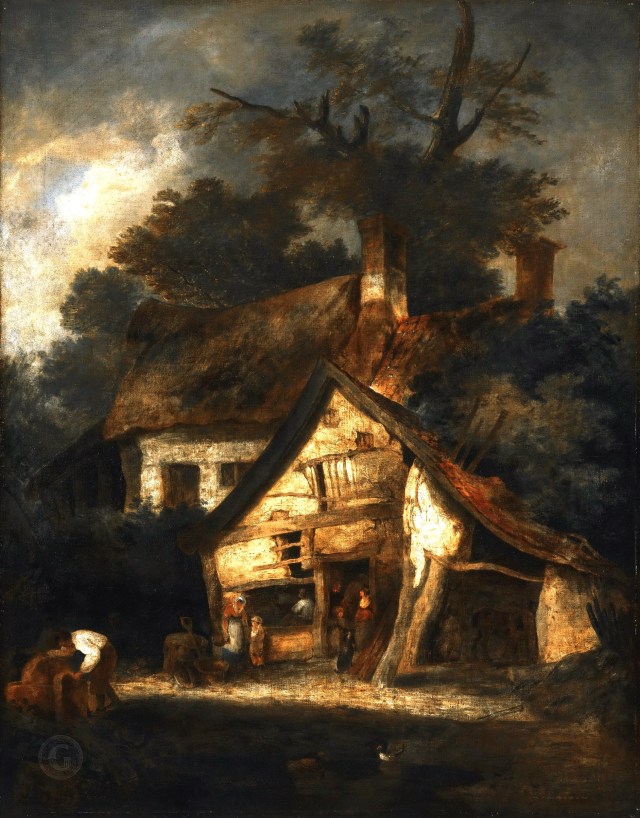
The Blacksmith’s Shop Near Hingham, Norfolk (1808)*
Oil on canvas 154 x 122 cm
Philadelphia Museum of Art
(*) The photo is an HD image provided by http://www.gallerix.ru
To enlarge the image, right-click on it and open it in a new tab
Although most of “Old” Crome’s artistic production took place in the first half of the XIXth century and therefore that puts him out of the Old Masters’s scope I decided to bend the rules (why not?) and dedicate him a place here because of this particularly beautiful landscape inspired by Gainsborough.
John Crome, known also as “Old” Crome to differentiate him from his son who was also a landscape painter, was born in the year of the foundation of the Royal Academy (1768). He was the son of an innkeeper and weaver of Norwich. He had no formal schooling and as an artist was essentially self-taught. His next fifteen years are poorly documented. He set up as a painter on his own shortly after 1790; by 1792 evidently, he was selling enough of his work to marry and start a family. During these years Crome met a local patron of the arts and collector named Thomas Harvey of Catton House. He commissioned paintings from him and, most importantly, introduced him to two important artists from London: the portrait painters William Beechey and John Opie; they transmitted to him very valuable knowledge about oil painting techniques.
John Crome remained for the rest of his life in Norwich, visiting London on a few occasions, and the Continent in 1814 when he visited Paris after the fall of Napoleon. He was president of the Norwich Society of Artists and exhibited there regularly. He also exhibited at the Royal Academy. He died in 1821
This early masterpiece from Crome shows the tumbledown shack thrown up against the side of a thatched cottage used by the blacksmith for the villages of Hingham and Hardingham each about 12 miles south-west of Norwich. The dense, full foliage of the trees and the warm-coloured, stormy sky indicate a scene in midsummer; the whole breathes an air of intense stillness on a warm afternoon in the countryside. Crome used the motif of the shop in picturesque dilapidation set against a verdant landscape to create one whole in a harmonious melding of shapes and tones.
Nearly all commentators on Crome agree on the importance of The Blacksmith’s Shop; it has been seen as a response to Gainsborough’s The Cottage Door (Huntington Library and Art Gallery, San Marino, USA). Crome’s painting is an essay in the picturesque very much in the spirit of The Cottage Door which belonged (until its sale in 1807) to Crome’s patron, Thomas Harvey. Crome is known to have copied it. There are, however, important differences between the intentions of both painters. Gainsborough’s lighting and composition have a theatricality and artificiality very different from Crome’s straightforward description. Gainsborough’s cottage and its inhabitants are idealized visions of living out a pastoral idyll. Crome´s painting is a factual record of a typical poor man´s cottage.
 Old Masters