
THOMAS GAINSBOROUGH
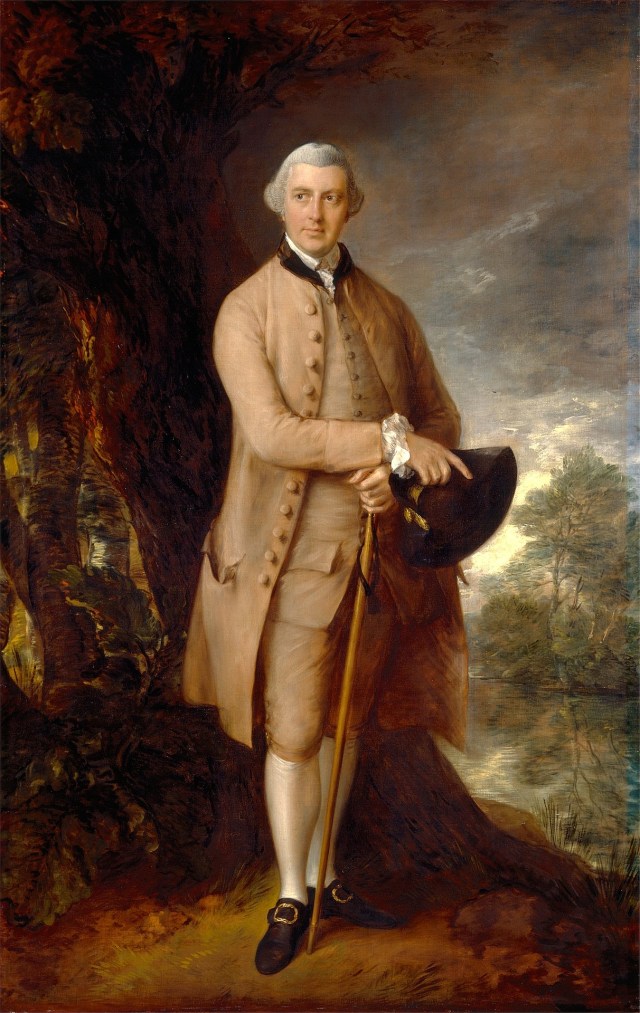
William Johnstone-Pulteney, later 5th Baronet (1772)
Oil on canvas (237 x 150 cm)
Yale Center for British Art, Yale, Connecticut, USA
To enlarge the picture, right-click on it and “Open in a new tab”
In an undated letter addressed by Gainsborough to Johnstone-Pulteney, the artist reveals how much did he care for his portraits. The fact that he endeavoured to achieve the most exact likeness is clearly reflected in the following paragraph:
“I think we could still finish a little higher, to great advantage, if it would not be intruding too much upon your good nature to bestow one more little sitting of about half an hour… I am fired with the thoughts of Mrs Pulteney is giving me leave to send you to the Royal Exhibition, and of making a good Portrait of you” (1)
Born in 1729 in Westerhall, Dumfries (Scotland), William Johnstone was the third son of Sir James Johnstone, 4th Baronet. As a young man he moved into Scottish intellectual circles, and among his friends were Adam Smith and David Hume. In 1760 he married Frances Pulteney, heiress to the Pulteney estates through her relationships to the earls of Bath; in 1767, when he succeeded to her lands and wealth, he added the Pulteney name to his own.
Gainsborough painted Johnstone-Pulteney with his usual straightforwardness, capturing the sitter’s modesty and dignity admirably. To which extent this is a truthful portrait of the man can be gathered by the following extract of Mr Pulteney’s obituary:
“Under a forbidding exterior and still more neglected or almost threadbare dress which he usually wore, he manifested a strong sense, a masculine understanding, and very independent as well as very upright principles of action” (2)
As a man of “upright principles of action”, Pulteney ardently supported the American colonies in their bid against taxation without representation; nonetheless, he steadfastly promoted continued union with the colonies and eventually met with Benjamin Franklin in Paris in 1773 in a futile attempt to find a peaceful solution to the conflict. To be honest, his interest in the colonies’ fate stemmed not from “upright principles” but from his ownership of over 1.000.000 acres of land between Lake Ontario and the Pennsylvania border.
Vocal and active not only in politics, Pulteney financed projects of artistic and scientific merit in Bath and beyond. In 1790, for instance, he helped to fund the first Chair of Agriculture at Edinburgh University. Closer to home, he continuously, though not always successfully, funded major projects of urban development. At the same time this portrait was being painted, in fact, he was deeply involved in the planning and building of Pulteney Bridge, one of Bath’s most significant landmarks and a monument to the Neoclassical vision of its architects, Robert and James Adam.
The beautiful landscape in the background shows the influence of the Flemish school and the way Gainsborough reacted to it. It is a fact that Gainsborough loved to paint landscapes and regretted that portraiture left him with very little time to indulge in it.
(1) Quoted by Mary Woodall in “Letters of Thomas Gainsborough” (1963) p. 127
(2) Quoted by Malcom Cormack in “The Paintings of Thomas Gainsborough” (1991) p. 110
 Old Masters