
FRANCOIS GIRARDON (1628-1715)
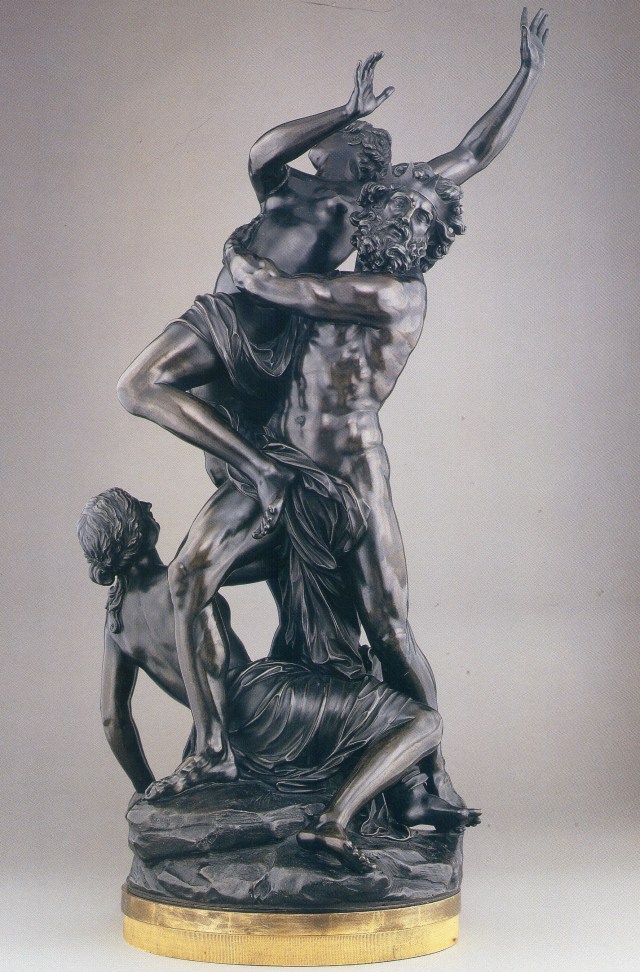
The Abduction of Proserpine (1693-1710)
Bronze = Height: 105 cm
Paul J. Getty Museum, Los Angeles
To enlarge the picture, right-click on it and “Open in a new tab”
Girardon, the most important sculptor of Louis XIV, had a solid academic background thanks to a scholarship provided by Chancellor Seguier. The young sculptor was sent to Rome where he spent five years (1645-50) studying antique and modern sculpture. When he returned to France he became a protégé of Charles Le Brun, principal painter to the king and virtual minister of the Fine Arts. Thanks to the influence of the almighty minister the royal commissions grew in number and importance.
This bronze is inspired by a monumental sculpture in marble made by Girardon as part of an ambitious project that contemplated four sculptural groups, each by a different artist, that would represent The Four Elements. Girardon represents the Fire by an analogy between the element and the figure of Pluto king of the infernal underworld. The sculpture reproduces the moment when Pluto abducts Proserpine the beautiful daughter of Ceres.
In the conception of this group, it is quite clear that Girardon had studied the famous group by Giambologna The Abduction of a Sabine Woman (1581-82) in the same way as the Italian sculptor he designed a group that can be observed from every angle. The other source of inspiration was Bernini’s own Pluto and Proserpine. Girardon avoided the theatrical gestures of the Italian’s work. He gave to his sculpture the nobility and decorum typical of French classicism
 Old Masters