
ANTON MARIA MARAGLIANO (1664-1739)
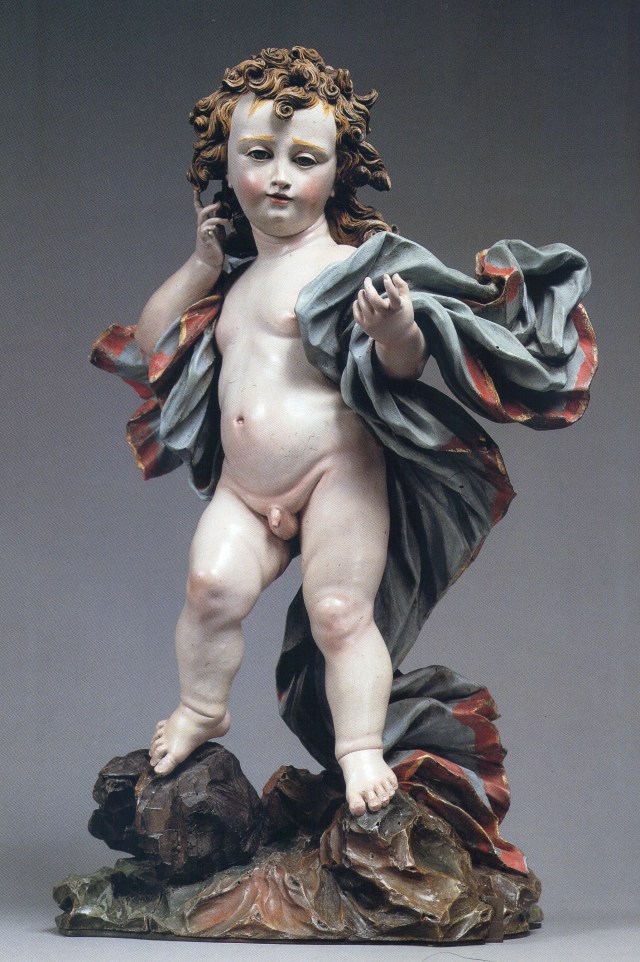
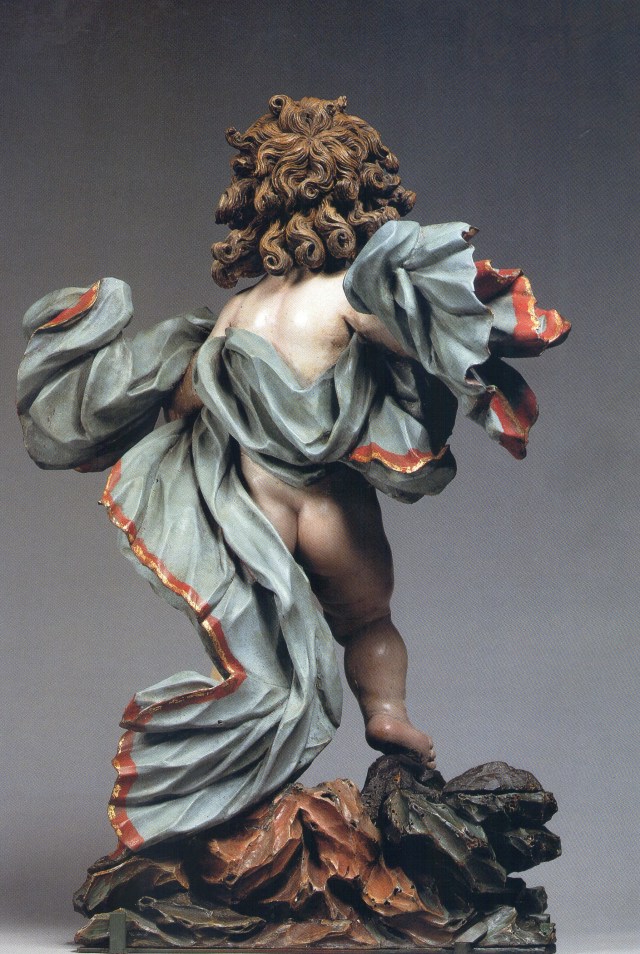
The Child Christ (c. 1700)
Painted wood with glass eyes (Height: 73 cm)
Paul J. Getty Museum, Los Angeles
To enlarge the pictures, right-click on them and “open in a new tab”
Born in Genoa, the son of a baker, Anton Maria Maragliano entered as an apprentice in his maternal uncle’s workshop at the age of 16. By 1688 he had his own workshop where he trained his son Giovanni Battista and the sculptors Pietro Galleano and Agostino Storace. He is well known for his sculptures in wood where he revolutionized the technique achieving dramatic effects. His works show an aristocratic refinement and, at the same time, a deep religious feeling. His workshop was highly successful and supplied hundreds of churches and convents with Madonnas, saints, crucifixes and images of Jesus.
He renewed the art of wood in a Baroque and pre-Rococo key, carrying out a reform linked to the poetics of great decoration carried out simultaneously by Filippo Parodi in marble and Domenico Piola in painting and implementing an effective compromise between courtly inspiration and popular taste. The spectacular theatricality of many of his complex sculptural groups is achieved with virtuosic twists and swirling drapery clearly inspired by the Roman Baroque.
This sculpture represents the Child Christ standing on a rocky landscape, he is naked except for a cloak wrapped around his body that flutters in the wind. He extends his left hand, probably to present an object lost, it could have been an orb symbolizing Christ’s role as Salvator Mundi (the world’s Saviour) or a bunch of grapes symbolizing the wine of the Eucharist. He raises his right hand to his ear in a gesture that indicates that he listens to all the prayers. This type of sculpture that is meant to be seen from every angle is obviously an image made for processions something very important in Catholic liturgy, especially in Italy.
 Old Masters