
JOSEPH WRIGHT ARA (1734-1797)
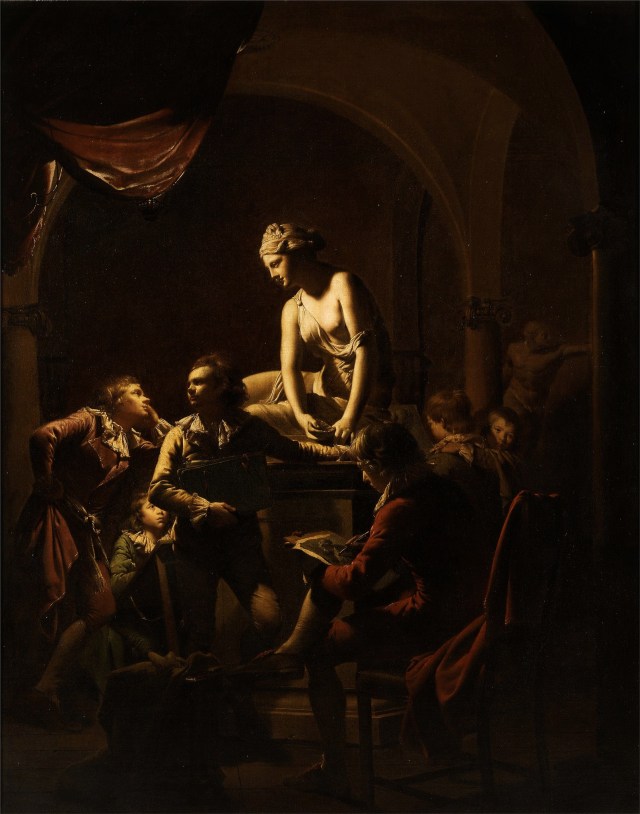
Academy by Lamplight (1768-69)
Oil on canvas (127 x 101 cm)
Yale Center of British Art, Yale, Connecticut, USA
To enlarge the picture, right-click on it and “Open in a new tab”
Born to a family of lawyers Joseph Wright decided to become a painter and in 1751 set off to London where he studied for two years under Thomas Hudson, the master of Sir Joshua Reynolds. In 1753 he returned to Derby and settled there. He varied his work in portraiture, through the production of genre scenes with a strong chiaroscuro under artificial light, and by landscape paintings. In 1773 he visited Italy where he spent two years, painting mainly landscapes. In 1777 returned to Derby where he remained for the rest of his life painting mainly portraits. Wright was a frequent contributor to the exhibitions of the Society of Artists and to those of the Royal Academy of which he was elected an associate in 1781.
From the outset of his career, Wright’s name and reputation had been closely associated with the tenebrist style born in the XVII century; this style that had its origin in Caravaggio took an international scope with the work of numerous admirers and followers, particularly Dutch and French. From 1756 until the exhibition of this picture, he exhibited paintings featuring scenes spectacularly illuminated by candlelight.
Wright painted two versions of this subject; the first one, in 1769, remained in private hands until its sale by Sotheby´s in December 2017; the second version, shown here, was painted in 1771 and purchased by Paul Mellon in 1964. This version presents two significant differences from the previous one: In the first place, Wright illuminated the background making visible the Gothic vaulted ceiling of the room where the students are working and in the second place he added a copy of the famous Greek statue known as The Borghese Gladiator.
This work is an analogy to the Pygmalion story, a subject particularly popular in the XVIII century, which basically deals with the subjects of artistic genius and the magical and subjugating power of Beauty. According to the Roman poet Ovid, Pygmalion, a Cypriot sculptor, carved the figure of a beautiful maiden out of ivory, she was so beautiful that he fell in love with her. On the day dedicated to Aphrodite Pygmalion asked the goddess for a bride that would be “the living likeness of my ivory maid”, Aphrodite granted Pygmalion his wish and as he kissed the statue she turned into a beautiful woman.
Pygmalion´s story inspired numerous artists; among them, Bronzino, Boucher, Etienne Falconet, Burne-Jones and Rodin. Perhaps the most famous and, in my opinion, most beautiful painting depicting Ovid´s tale is Jean-Léon Gérôme´s Pygmalion and Galatea (New York, Metropolitan Museum of Art)
Wright shows here the different faces of the aspiring artist. While some serious draftsmen carefully copy the object before them, one student stands at the centre of the scene, his portfolio clutched to his breast, looking away. Has he finished the drawing? Is he interested, or not, in the assigned task?
In the shadows at right, a very young pupil, with his inviting gaze, encourages the viewer to partake in the scene. At the left, a besotted student has left his drawing tools and looks adoringly at the sculpted nymph.
The statue, illuminated by the yellow candlelights, glows in the deep shadows as if she soon will rise and leave the plinth. The young artist stares at the maiden, bewitched by her beauty. Intriguing as the narrative may be there is no doubt that the picture’s subject is the enlivening and transformative power of Beauty.
 Old Masters