
WILLIAM HOGARTH (1697-1764)
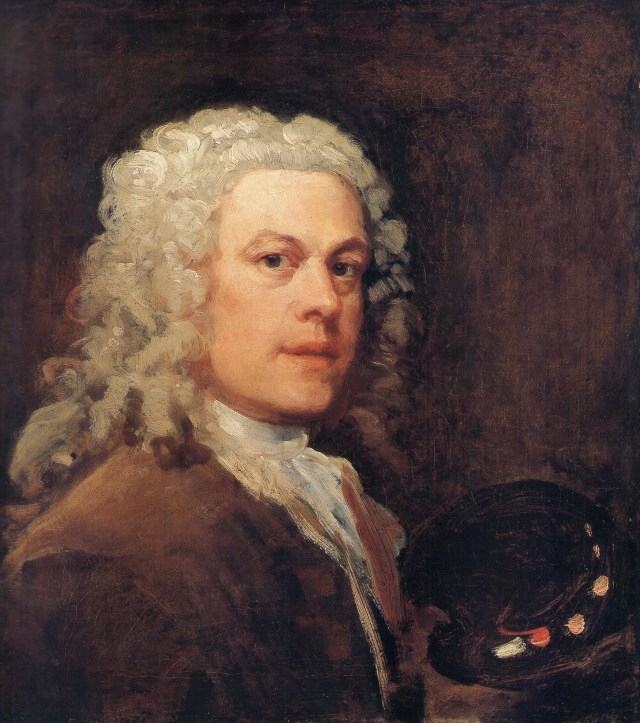
Self-portrait (1730’s)
Oil on canvas 54 x 51 cm
Yale Center for British Art, Yale, Connecticut, USA
Hogarth was among the most skilled, financially astute, and patriotic artists of his generation. Much of his subject matter was inspired by his own difficult childhood, marked strongly by his father’s confinement to the debtor’s prison. After an early apprenticeship to the engraver Ellis Gambel in 1713 and studying at the St. Martin’s Lane Academy, he quickly established a career as an engraver of satirical prints. His first attempt at a major painting came in 1728, with his five versions of a scene from John Gray’s The Beggar’s Opera. Hogarth was the first painter in England to fully exploit the market for prints. engraving his own works and thereby lessening his dependence on patrons.
Throughout his life, he sought to improve the status of the artist in England and establish a British school of painting that would rival those of the Continent. While his genre scenes brought him much attention and praise in his own lifetime, and his portraits are today highly praised for their freshness and insight, Hogarth’s lifelong ambition of becoming a respected history painter was never realized.
This is Hogarth’s earliest known self-portrait, a work of painterly improvisation that denotes a great talent. He clearly reworked the portrait constantly, adding and changing details of the composition as he painted. For instance, he had painted himself wearing a soft cap, the switch to a powdered wig may have resulted from his desire to present himself as a fashionable gentleman (let’s not forget his aim to raise the social standing of the British artists). The addition of the palette, awkwardly wedged into the lower right corner, clearly articulates his desire to be seen as a painter. I wonder if this is an echo of Tiziano’s famous 1567 Self-portrait (Madrid, El Prado) where the old master depicts himself wearing the gold chain bestowed on him by Emperor Charles V and, at the same time, holding his brushes in a proud statement about his condition as a gentleman-painter.
 Old Masters