
SIMON VOUET (1590-1649)
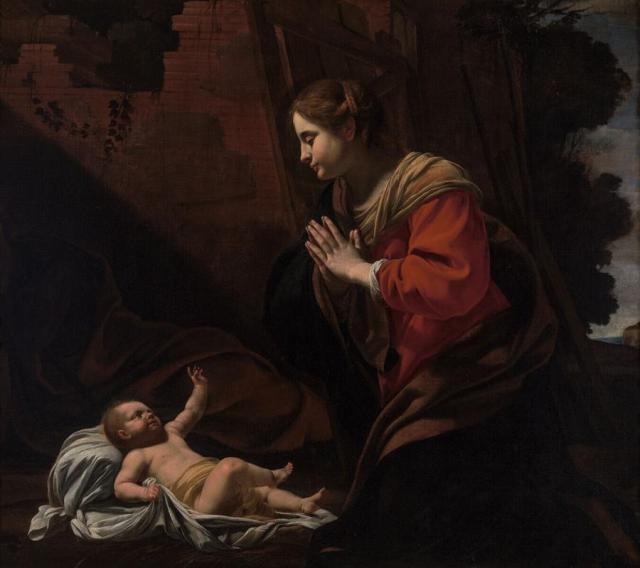
The Madonna Adoring the Christ Child (1623-26)
Oil on canvas 118 x 132 cm
Museum Boymans-van Beuningen, Rotterdam
To enlarge the picture, right-click on it and “Open in a new tab”
Simon Vouet is one of the most important French painters of the 19th century. His father Laurent, a painter himself, taught him the rudiments of his craft. The boy was very talented and at a very early age began to paint in oils. In 1611 he was part of a French diplomatic mission to the Ottoman Empire, his task was to portray members of the imperial family. From Constantinople, he went to Venice where he spent two years studying the Venetian masters of the XVIth century. By 1614 he was in Rome, and he stayed there until 1627. He incorporated into his style the dramatic chiaroscuro of Caravaggio, the rich colour of Veronese and the elegance of Guido Reni.
Despite his success in Rome, Vouet returned to France in 1627 following a summons from the king. His new style was distinctly Italian, introducing the Baroque in France. He adopted his style to the grand manner of the decorative schemes commissioned by Louis XIII and Richelieu. He was made Premier peintre du Roi. The king commissioned from his portraits, cartoons for tapestries, and allegorical compositions for the Louvre, the Palais du Luxembourg, and the chateau of Saint-Germain-en-Laye. He formed a generation of French painters who would give the French baroque its elegant, restrained classicism.
This work reflects the influence of Caravaggio in Vouet in its dramatic chiaroscuro but, at the same time, there is a distinctly classical elegance in the figure of the Virgin that denotes the influence of Guido Reni. The warm colours of the Virgin’s garments complement the rich, dark brown of the background.; and, at the same, time brighten up the scene. The Child Christ, his left arm raised in benediction, is also illuminated like the Virgin Mary.
The painting had been attributed to the Neapolitan painter Paolo Finoglio until Richard Spear identified it as a work from Vouet in 1972; this attribution has never been questioned since and the study of Vouet’s production during the 1620s shows a clear similarity with this particular painting; in fact there is an altarpiece (The Circumcision) that Vouet painted in 1622 where the figure of the Madonna is almost exactly the same as in the Rotterdam painting.
 Old Masters