
FRANCIS WHEATLEY RA (1747=1801)
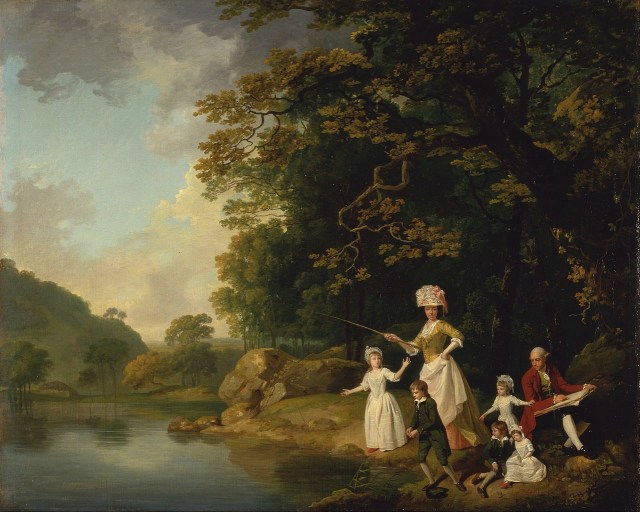
The Browne Family (c.1778)
Oil on canvas (70 x 89 cm)
Yale Institute for British Art, Yale, Connecticut, USA
To enlarge the picture, right-click on it and “Open in a new tab”
Wheatley was born in Covent Garden, London; he studied at William Shipley’s drawing school and the Royal Academy and won several prizes from the Society of Arts. He first exhibited at the Royal Academy in 1778 and was praised by the critics. He built up a good practice but he soon fell in extravagant company and was forced to flee to escape from his creditors. He settled in Ireland in 1779 and established himself as a portrait painter. He was very successful, among his most important works of this period is the huge canvas The Irish House of Commons (1780) which won him widespread praise and popularity. He returned to London where he dedicated himself to painting landscapes and genre scenes. He was elected an associate to the Royal Academy in 1790 and an academician the next year.
Wheatley shows George and Mary Browne and their children pursuing various fashionable leisure activities on the banks of a calm river or pond. Actively engaging the viewer with her stare, Mrs Browne dominates the canvas. She cuts a commanding figure, jauntily hitching up her white apron to avoid soiling it with the muddy water lapping against the bank. Her fancy ribboned hat seems out of place in such a natural setting, yet it does serve to shade her eyes from the midday sun. Her husband, also fashionably dressed for their outing, relaxes with his family while he sketches by the water. Strangely enough, Wheatley has reversed the traditional gender roles: the woman is fishing whereas the husband is sketching, a pastime proper for ladies
Wheatley’s picture shows the continental influence of the so-called Italian landscape; a genre developed by the northern European artists working in Italy towards the end of the XVIIth century. There is a golden hue on the horizon showing the end of a warm, sunny day.
Picnicking, fishing and drawing had become by the mid-eighteenth century suitable recreational activities for all classes of British society. Wheatley’s painting not only depicts a family engaged in pleasurable pastimes but also reflects current ideas on child-rearing. In the 1760s Jean-Jacques Rousseau’s novel Emile, a treatise on the proper education of the child influenced how couples treated their children. Rousseau counselled parents to become involved in their children’s upbringing and emphasized the positive effects of outdoor activities. Incidentally, Rousseau was a hypocrite and a vile human being who dropped off at the nearby foundling hospital each of his five children who apparently died of neglect, the miserable did not even bothered to keep in touch with the authorities about their fate.
 Old Masters