
JAN SIBERECHT (1627-1703)
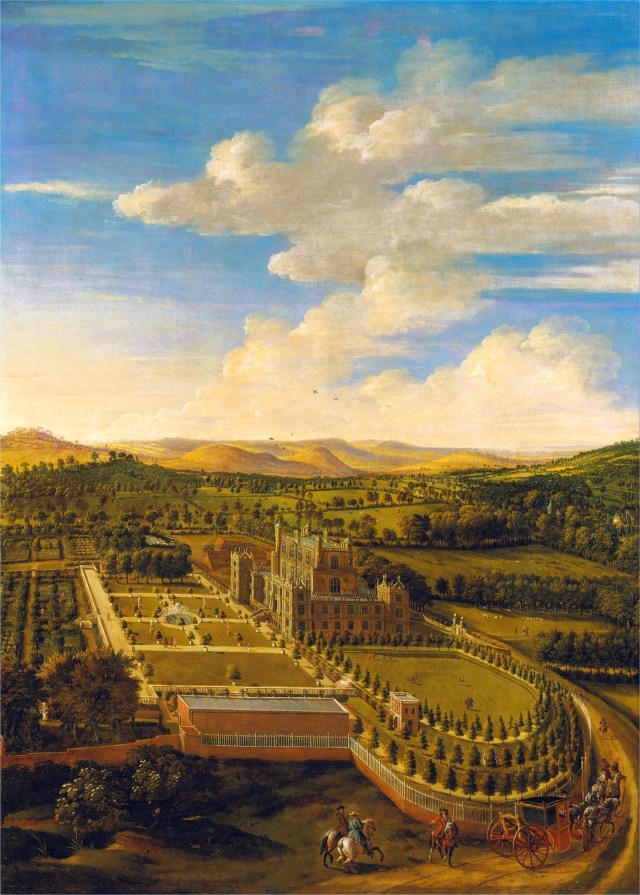
Wollaton Hall and Park, Nottinghamshire (1697)
Oil on canvas 192 x 138 cm
Yale Center for British Art, Yale, Connecticut, USA
To enlarge the picture, right-click on it and “Open in a new tab”
Jan Siberecht was born in Antwerp, the son of a sculptor of the same name. He trained with her father and became a master of the Guild of Saint Luke in 1648. It is possible, but not certain, that in the late 1640’s or early 1650’s he visited Italy. He developed a peculiar style of landscapes that impressed George Villiers, 2nd Duke of Buckingham when he visited the Netherlands in 1670. The Duke invited him to England. Siberecht arrived in England in 1672; he spent the first three years painting decorations in the Duke’s newly built Cliveden House in Taplow, Buckinghamshire.
In the late 1670’s and the 1680’s, he travelled throughout England completing numerous commissions for aristocratic clients. Siberecht’s speciality was the views of country houses and hunting scenes. His landscapes presented large, powerful trees in the foreground that framed the composition. The foreground was kept relatively dark in order to draw attention to the broad, brightly lit vista in the background. Siberecht’s hunting scenes constitute the earliest portraits of country houses in England. He used a fairly standardised formula: the hunting scene with the huntsmen was depicted in the foreground and a naturalistic view of the stately home was in the background. He adopted a bird’s-eye view that allowed the maximum of detail.
This painting is a typical example of Siberecht’s work. In his time these views were known as “a prospect”. The formula was developed by artists in the Netherlands and flourished in England from the late XVIIth century to the mid-XVIIIth century. With its comprehensive, bird’s eye perspective it offered the landowner the pleasure of seeing his property laid out before him as a whole.
Wollaton Hall, a short distance west of Nottingham, is one of the most important Elizabethan houses in Britain; it dates from the 1580s and the architect was probably Robert Smythson. It was designed as a grand showpiece proclaiming the wealth and status of its owner Sir Francis Willoughby (1547-1596), a coal magnate-cum-entrepreneur. In 1688 Wollaton passed to Sir Thomas Willoughby Bart.; it was he who commissioned Siberecht to paint this and other views of his estate. He clearly took a great deal of pride in Wollaton, he remodelled parts of the interior of the house, commissioned mural decorations and installed in the park formal gardens in the French style.
The view in the painting, which is from the southeast, gives a fairly faithful account of the mansion’s appearance. Like most prospects, it records the owner’s improvements to his estate and the pleasures he could offer to his guests there.
 Old Masters