
ANTON VAN DYCK (1599-1641)
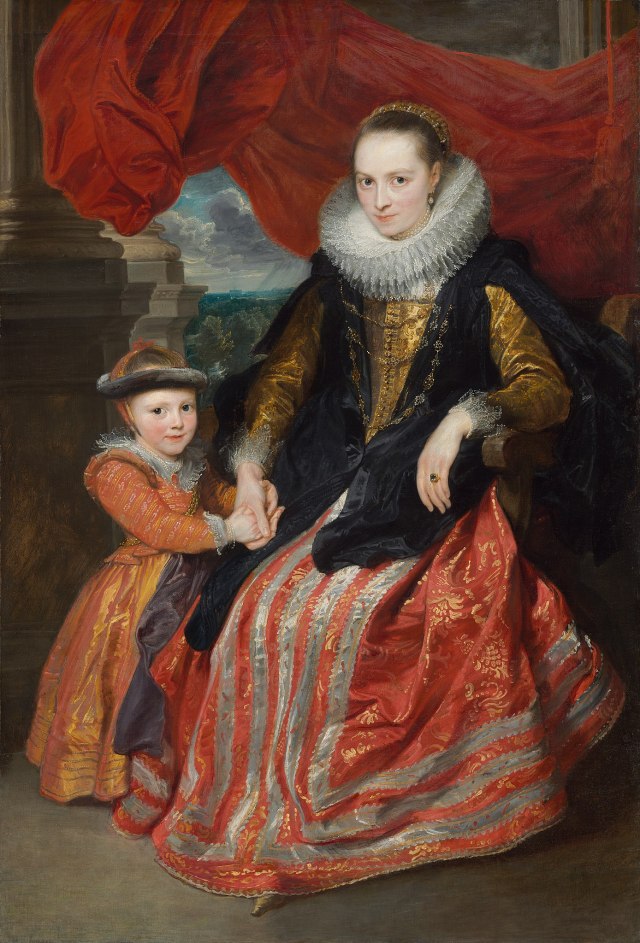
Portrait of Susanna Fourment and her Daughter Clara (1620-22)
Oil on canvas 173 x 117 cm
National Gallery of Art, Washington DC
To enlarge the picture, right-click on it and “Open in a new tab”
The sitters have been identified with complete certainty. Susanna Fourment (1599-1628) and her daughter belonged to Rubens’s extended family. Rubens was married to Susanna’s sister-in-law Isabella Brant, and it was probably through Rubens that Van Dyck received the commission for this portrait. Susanna’s brother Daniel was related to Rubens by marriage, and her younger sister Helena became Rubens’s second wife in 1640. Clara, who was born in 1618, married Rubens’s eldest son, Albert, in 1641. Judging by her age, the present portrait cannot have been painted much earlier than 1620-22.
Although the formula of a well-dressed young matron facing to the left and seated in front of an impressive architectural background was by this time standard in van Dyck’s repertoire, few if any of his previous portraits of comparable sitters were full-length; this suggests that the sitter was obviously a lady of high rank, as her magnificent dress and jewellery indicate. The shimmering red silk of the dress highlights the silver brocade brilliantly rendered by van Dyck with his usual flair. The lady’s penetrating gaze and tight lips reveal a certain haughtiness more suited to her palatial surroundings than to a townhouse. The little girl is an adorable creature, lively and sweet.
As the author of the corresponding entry on the website of the National Gallery of Art (Washington, DC) said: “In this tender image of a mother and daughter, Anthony van Dyck has conveyed the full extent of his artistic abilities. Even in a formal portrait like this one, he has ably captured the warmth, love, and reassurance of the parent-child relationship through gaze, gesture, and even bearing.”
The identification of Susanna is based on the likeness of her face with that of two works by Rubens: a drawing (in the Albertina, Vienna) and the wonderful portrait known as Le Chapeau de Paille (National Gallery, London) representing Susanna after her second marriage. The similarity between both women is extraordinary in both the drawing and the painting: both have a rather small head, a deeply elongated oval-shaped face, large eyes, high cheekbones, a small pointed nose and a narrow chin.
There are no records about the whereabouts of this picture after the death of Susanna´s husband, Arnold Lunden in 1656. It reappeared in 1749 in the sale of the collection of Anna Theresia van Halen, a lady from Antwerp. In 1769 it was acquired by Louis XV´s famous minister, the Duke of Choiseul; at his death, most of his paintings were bought by the prince Alexander Golitzyn for the empress of Russia Catherine II. It remained in the Palace of the Hermitage until 1930 when it was acquired by the American multimillionaire Andrew W. Mellon who bequeathed it to the National Gallery of Art in 1937.
 Old Masters