
ANTON VAN DYCK (1599-1641)
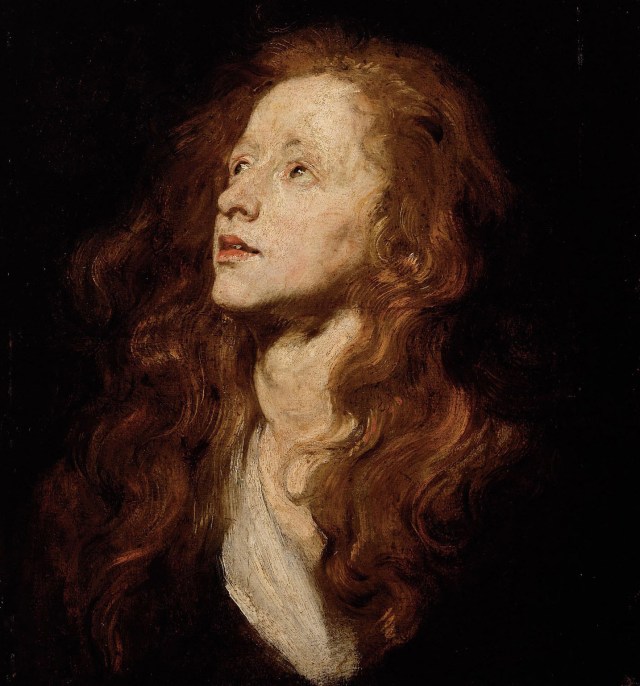
Head of a Woman (1618-20)
Oil on paper, mounted on panel 49 x 46 cm
Kunsthistorisches Museum/Museum of Art History, Vienna
To enlarge the picture, right-click on it and “Open in a new tab”
This oil sketch is akin to the studies from live male models that van Dyck transformed by the addition of appropriate attributes into his series of individual apostles. Van Dyck may have chosen to portray her in this oil sketch simply because of her fresh and innocent beauty. Because he posed her looking up into a brilliant light, it seems likely that he intended to use the sketch for a religious painting. He painted the same model in a different pose as Mary Magdalen looking down at a skull in contemplation of the transitory vanity of earthly life.
Dated around 1618 and 1620, this work belongs to the early years of his career as an independent artist. It is worth pointing out that van Dyck became a master painter and a member of the prestigious Painters Guild of Antwerp in 1618 when he was only 19 years old. The stunning quality of this study shows clearly how gifted and brilliant he was.
The brightly illuminated face was painted quickly, directly from the model, and as fluently as possible with rather a thick impasto on a heavily loaded brush. The result is a rich, creamy surface comparable to that of the Portrait of van der Geest (National Gallery, London). Her skin areas are opaque and warm in tone, turning cool in half-tones and warmish grey in the glazed shadows.
Van Dyck’s insight into the young woman’s personality is so acute and sympathetic, even affectionate, as to suggest an intimate, even familiar relation with her. He had three sisters in holy orders and, according to Bellori, he portrayed one of them as Mary Magdalen in the Lamentation that he painted for her convent church.
 Old Masters