
ANTON VAN DYCK (1599-1641)
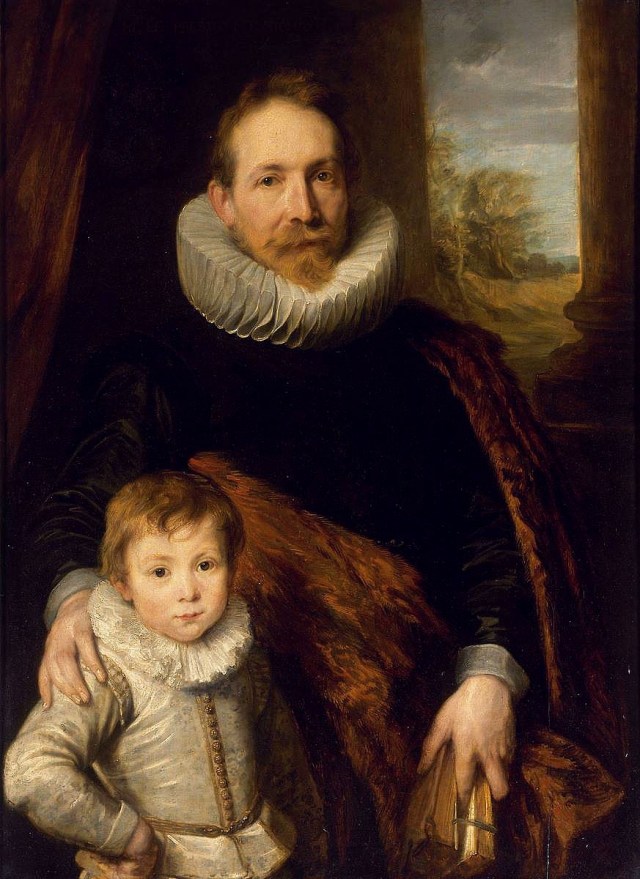
Portrait of a man and a boy (1618-20)
Oil on panel 115 x 82 cm
Musée du Louvre, Paris
To enlarge the image, right-click on it and “Open in a new tab”
The following paragraphs belong to the excellent monography about Anton van Dyck by the American art historian Alfred Moir (1924-2010) which was published in Thames & Hudson in 1994. My comments are in italics.
“The well-groomed gentleman and his son are presented so sympathetically as to suggest a personal relationship with van Dyck. Van Dyck may have known the man in Antwerp, either in Ruben’s circle of intellectual friends or among the Neo-Stoic scholar administrators who served in the city government.
The portrait is more likely to represent one of the sons of M. le Président Richardot (1540-1609); Jean (1570-1614) or Guillaume (1579-1640). Jean was the archduke’s ambassador in Rome while Rubens was there in 1602, and Guillaume was an intimate of Rubens’s beloved older brother Philip, with whom he had been a student of the influential Neo-Stoic philosopher Justus Lipsius. At some point, a strip of canvas about two inches high with the inscription “M. le Président Richardot” was added along the top of the painting.”
The strip of canvas added to the painting with the purpose of identifying the sitter as Jean Richardot the Elder (1540-1609) was a very clumsy and silly attempt to rewrite history since Anton van Dyck was barely 10 years old when Richardot the Elder died. Incidentally, he was known as “the President” due to his appointment as Chief-President of the Privy Council (1597-1609) by Archduke Albert of Austria, Governor General of the Netherlands.
It was suggested that the sitter was the German philologist and scholar of Dutch descent Johann von Wouwern (1576-1635) also known as Johannes Wouwerius or Jan van den Wouwern who was a close friend of Rubens and his elder brother Philip. However, Wouwerius never married although he is supposed to have fathered several children out of wedlock. Assuming this is true, the fact he did not mention any children in his testament means he did not care about them and would have never chosen to be portrayed with any of them. Having said that, there is a portrait of Johannes Wouwerius by van Dyck; a half-length painted about 1630-32, in the Pushkin Museum of Fine Arts in Moscow (106 x 86 cm). Unfortunately, I could not obtain a large, high-quality image to reproduce it here.
“The characterization of the father and son is brilliant, individuating each personality and simultaneously relating them to each other. The man’s experience contrasts with the innocence of the boy, who stands like a little man, proud of his father. Both son and father convey a sense of security: the boy under his father’s protective hand, and the man less from his evident prosperity than in his calm, philosophical assurance.
The actual handling is exemplary of van Dyck’s virtuosity with the brush and the pigment, ranging effortlessly from the rich impasto in the boy’s ruff through the smooth glazing of the man’s face to the spontaneity of the undisguised brushstrokes forming the landscape. The boy’s right hand has been left unfinished, but everything else in the painting appears to be carried to completion, even the very summary sketching of the fur seems intentional, to produce an almost tactile illusion.” (1)
(1) Alfred Moir: “Van Dyck” Thames & Hudson, London, 1994 (p. 62)
 Old Masters