
JOHANN ZOFFANY (1733-1810)
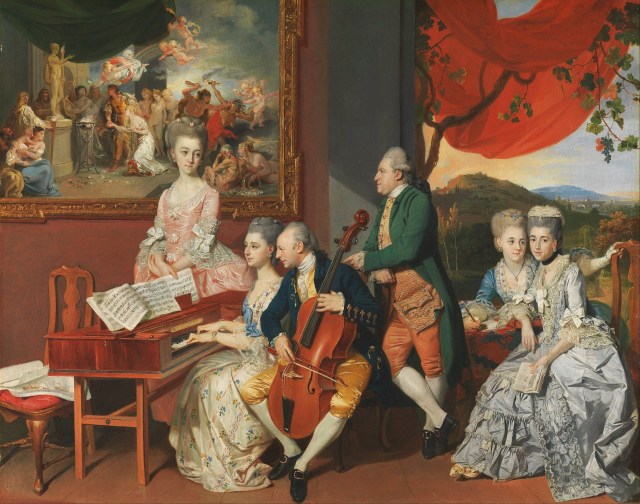
The Gore Family with George, 3rd Earl Cowper (1775)
Oil on canvas (78 x 98 cm)
Yale Center for British Art, Yale, Connecticut, USA
To enlarge the picture, right-click on it and “Open in a new tab”
Of Hungarian and Bohemian origin Johan Zoffany was born in Frankfurt on 13 March 1733. He undertook an initial period of study in a sculptor’s workshop in Ellwangen in the 1740s. In 1750 he travelled to Rome, entering the studio of Agostino Masucci. In the autumn of 1760, he arrived in England, initially finding work with the clockmaker Stephen Rimbault, painting vignettes for his clocks.
By 1764 he was enjoying the patronage of the Royal family for his charmingly informal scenes like Queen Charlotte and Her Two Eldest Children (1765, Royal Collection) in which the Queen is shown at her toilette with her eldest children. He was also popular with the Empress Maria Theresa of Austria who made him a Baron in 1776.
A founding member of the Royal Academy, Zoffany enjoyed great popularity for his society and theatrical portraits, painting many prominent actors and actresses, in particular, David Garrick, the most famous actor of his day. Besides being a successful portrait painter, he was a master of what was called “the conversation piece”; it consisted of an informal group portrait of a family or friends in a rather small format. This genre had been created in the Netherlands and France during the 1720s.
In the later part of his life, Zoffany was known for producing very large paintings with a great number of persons admiring works of art, in a way reminiscent of the old Dutch and Flemish “gallery paintings” of the 17th century that showed a connoisseur surrounded by his friends admiring his collection. The most famous of this genre is the huge The Tribuna at the Uffizi (1772, Windsor Castle, Royal Collection)
Johan Zoffany died in his home at Strand-on-the-Green on November 1810
In this lavish portrait, George 3rd Earl Cowper (1738-1783) leans nonchalantly on the back of a chair and looks at his future wife, Hanna Anne Gore; the poor girl does not seem very happy about it. Surrounding the couple is the bride’s family; her father Charles Gore plays the cello while the elder sister Emily accompanies him on the pianoforte; her mother Mary Gore, book in hand, and her eldest sister Elizabeth are seated on the right.
Anne Gore married George Cowper, who was 21 years older than her, on 2 June 1775. The painting was commissioned by her father to commemorate their betrothal. Cowper was a keen art collector and his art collection absorbed a great deal of his time and money. Among his most notable possessions were two paintings by Raphael. The first is known as The Small Cowper Madonna and the other is the The Niccolini-Cowper Madonna; both are nowadays in the National Gallery of Art, Washington, DC.
Set in an open gallery in Cowper’s villa, the intimate family portrait describes the members of the Gore family as well as their affection for each other. Opulent in the description of every detail of the dresses, musical instruments and furniture, this conversation piece is more than a mere depiction of an intimate family afternoon. Zoffany has given us an idealized image of the couple and her family but also of their tastes and lifestyle.
The Gore family arrived in Italy in 1773; they settled in Florence and there, through their introductions to the Grand Ducal Court and the highest ranks of British society, they met George Clavering-Cowper, 3rd Earl Cowper. He was a great patron of contemporary British artists, musicians and literati whom he frequently championed to the Grand Duke of Tuscany. Cowper was also a bit of a snob in the sense that he was very keen to be associated with those whom he considered his social superiors, that is why he strove to, and achieved, to be made a Prince of the Holy Roman Empire (Prince of Nassau de Auverquerque). In a letter to Sir Horace Mann, Horace Walpole referred to him as: “…an English Earl who is more proud of a Pinchbeck (*) principality and a paltry order from Württemberg than he was of being a peer of Great Britain when Great Britain was something” (1) I have to see that I fully agree with Horace Walpole, “Prince of Nassau de Auverquerque” (2), how pathetic can you be?
(*) Pinchbeck is an alloy of copper and zinc that resembles gold. It was invented by Cristopher Pinchbeck (1670-1732), a London clockmaker. He claimed that he always labelled his fake gold jewellery as such; however, it did not take long for dishonest jewellers to start selling pinchbeck as real gold. Over the years the word became a synonym for a cheap and tawdry imitation of gold and, by extension, of anything valuable.
(1) Elizabeth Gibson: “Earl Cowper in Florence and His Correspondence with the Italian Opera in London” “Music & Letters”, Vol. LXVIII, No. 3, (1987)
(2) George Clavering-Cowper´s mother was Lady Henrietta de Nassau d’Auverquerque (1712-1747); she was the daughter of Henry de Nassau, Lord d’Auverquerque, 1st Earl of Grantham (1673-1754), a Dutch nobleman born Hendrik van Nassau, who was lord of Ouwerkerk, a small village in the south of the Netherlands, for some reason he adopted the French spelling of Ouwerkerk which is Auverquerque. He settled in England where he was created 1st Earl of Grantham by William III in 1689.
 Old Masters