
ANTOINE PESNE (1683-1757)
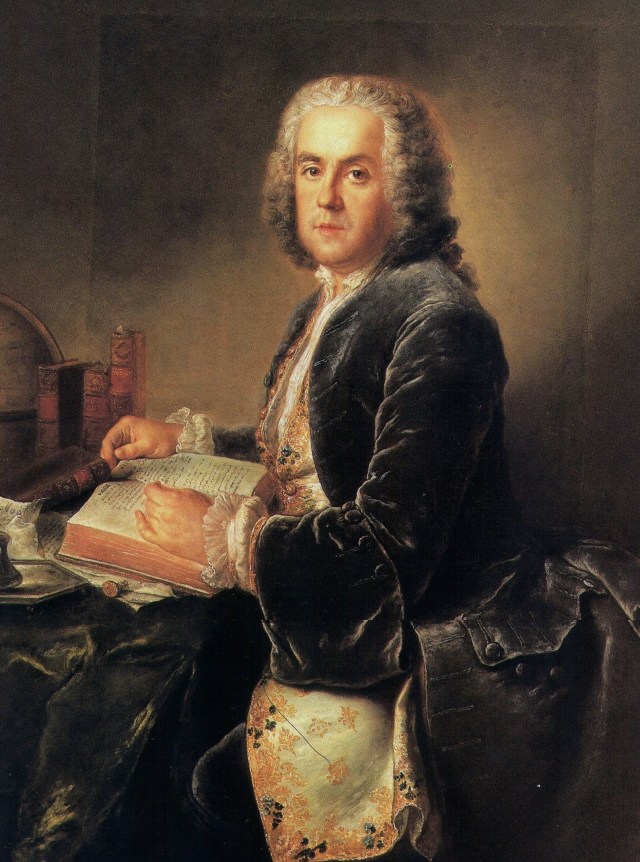
Portrait of Charles Etienne Jordan (1740)
Oil on canvas 145 x 110 cm
Huis Doorn, The Netherlands
To enlarge the picture, right-click on it and “open in a new tab”
Antoine Pesne, a nephew of the history painter Charles de La Fosse (1636-1716), went to Italy in 1704 after winning the prestigious Prix de Rome. He settled in Berlin in 1710, and a year later, following the death of Augustus Terwesten (1649-1711) was appointed painter to the Prussian court, where he went on to become an immensely successful portraitist.
The subject of the portrait, Charles Etienne Jordan (1700-1745) was the son of a French Protestant minister and theologian who was forced to flee France to escape persecution. Following his father’s steps, he became a minister after studying Theology at Magdeburg University. After his wife died in 1732 Jordan abandoned his religious career and set out on a journey through the Netherlands, France and England; the result of this pilgrimage was Histoire d’un voyage litteraire (1735) This work attracted the attention of the Crown Prince of Prussia, Frederick, who appointed Jordan as his literary secretary. In 1740 he was made Curator of the Berlin University and in 1744 Vice-president of the Prussian Academy of Sciences.
Shortly after completing the painting, Pesne was forced to enlarge it to make it a pendant for his Portrait of Dietrich von Keyserling, both paintings, as well as the equally large portraits of Egmont de Chasot and Henry de La Motte-Fouqué, were part of a series commissioned by Frederick the Great for the music chamber of the royal palace in Berlin. The entire series of portraits of the king’s companions are still at Huis Doorn (1).
Pesne’s attempt to enlarge the figure of Jordan in the painting was not entirely successful, as Jordan’s knee and the back of the chair are somehow unconvincing and awkward. From a technical point of view, the portrait of Jordan is the least accomplished work in the series. As a character study, however, it is undoubtedly one of Pesne’s finest.
(1) Huis Doorn (House Doorn) is a manor and museum near the town of Doorn in the province of Utrecht in the Netherlands. The house was rebuilt in the XIV century after being destroyed by a fire but it was substantially modified in the late XIX century. In 1920 the ex-Emperor of Germany and King of Prussia, William II, purchased the property where he lived until his death in 1941. The mansion is richly furnished with paintings, sculptures and furniture from former royal Prussian residences. Here is a link to its website: https://www.huisdoorn.nl/en/discover-the-museum/house-and-park/house-and-collection/
 Old Masters