
ANTON VON MARON (1713-1808)
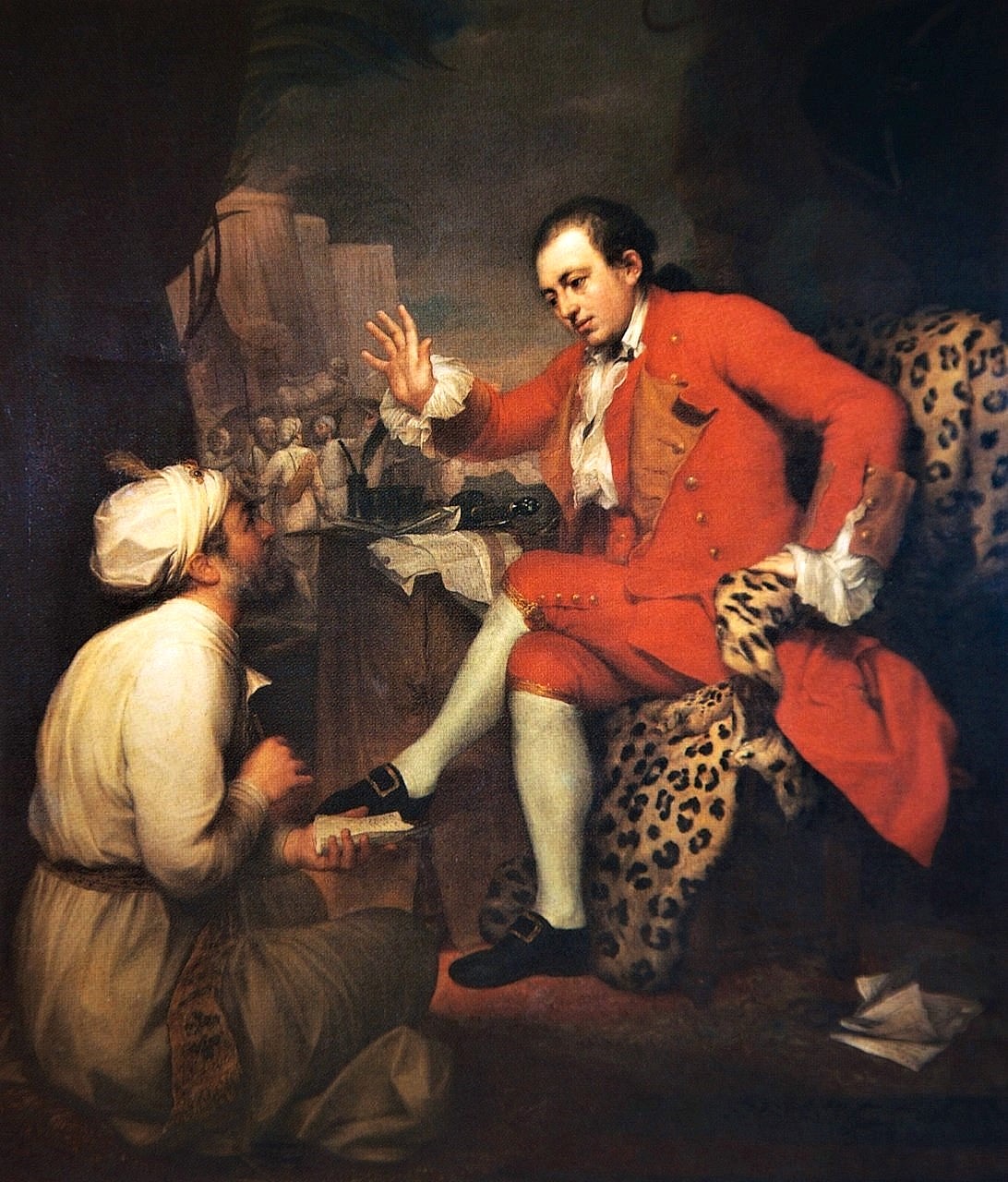
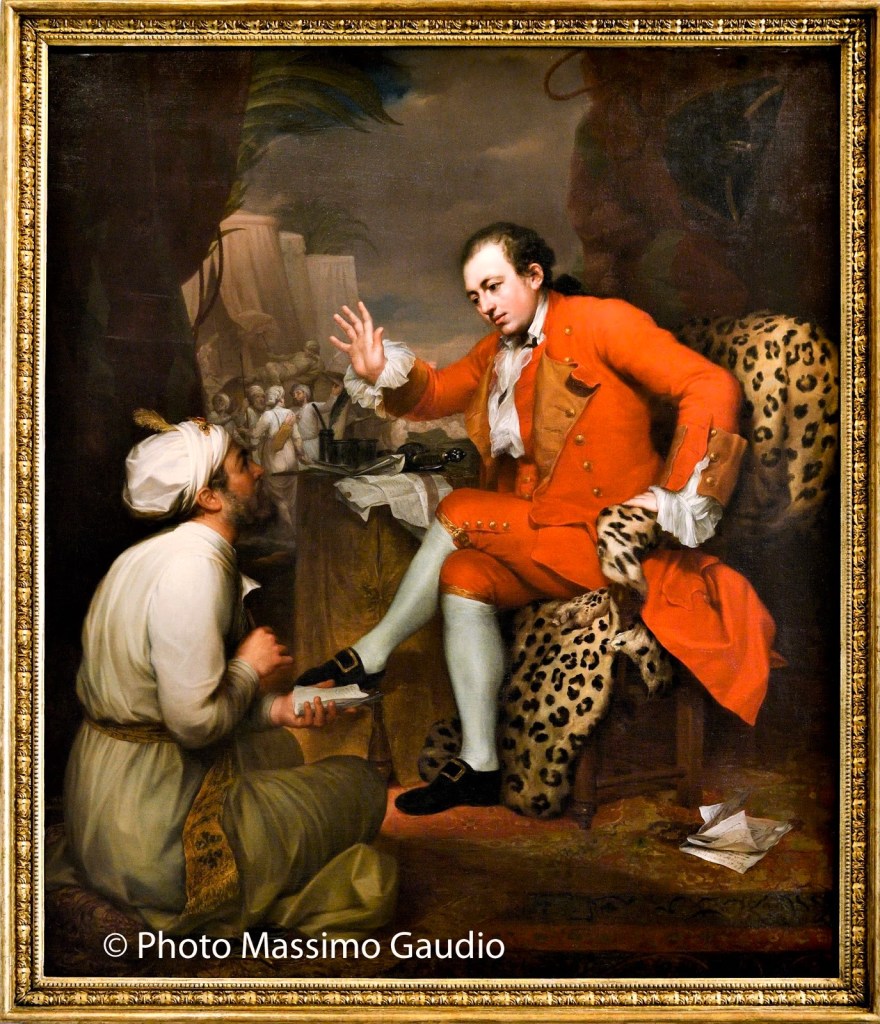
Portrait of Sir Robert Clive (1766)
Oil on canvas 150 x 120 cm
Galleria Nazionale d’Arte Antica, Palazzo Barberini, Roma
To enlarge the images, right-click on them and “Open in a new tab”
The first picture was scanned by me from the book “Settecento: L´Europe a Rome”, catalogue of the exhibition of the same name held between September and December 2000 in Paris. The second picture, of far superior quality, is from Massimo Gaudio´s blog (www.massimogaudioartblog.com) which I recommend visiting.
Anton von Maron (1713-1808) was not only a pupil and collaborator of Anton Raphael Mengs but also his brother-in-law. Following the steps of his master, he dedicated himself to portraiture building up an important clientele. In 1766 he was admitted as a member of the prestigious Saint Luke’s Academy and in 1772 was elected member of the Imperial Academy of Fine Arts of Vienna; to this honour, he also had the distinction of being ennobled adding a “von” to his surname.
The portrait of Sir Robert Clive (1725-1774) was painted during his stay in Rome on his way to India where he was to reassume his position as governor of Bengal. Strangely enough, the painting is signed and dated “Antonius Maron fecit Romae 1766″ which indicates that it was finished after Sir Robert left Rome. The painting must have been shipped to England since Clive did not return to Rome.
The composition is a bit odd, instead of the usual full-length portrait reserved to high ranking officers and noblemen, Maron chooses to represent Sir Robert as a benevolent ruler who from his high armchair dictates policy matters to his secretary whose lower ranking is symbolized by his position at Sir Robert’s feet. In the background, we can see tents that suggest a military camp with Indian soldiers assembled. On Sir Robert’s desk, his sword is clearly visible as a reminder of his military status and prowess.
Clive has been widely credited for laying the foundation of the British rule in India, exercised firstly by the famous East India Company (1600-1874). He began his career as a clerk for the EIC in 1744 but in 1747 he joined the Company´s army as an officer. He distinguished himseld in the siege of Arcot in 1751 where he captured the fort which he later defended with only 500 men against an Indian army of nearly 6.000 men. On 23 June 1757, Clive won a decisive victory over the forces of the Nawab of Bengal (1) establishing thus the supremacy of the EIC which replaced the hostile Nawab of Bengal for a pro-British one called Mir Jafar who awarded Robert Clive a yearly pension of £30.000 (the equivalent of £5.000.000 in 2023).
When he returned to England in 1767, Clive was the owner of a fortune estimated in £180.000 (the equivalent of £30.500.000 in 2023) Like all honourable men who refuse to get involved in sordid schemes and who do not tolerate them, Sir Robert Clive had many enemies; as Thomas Macaulay said: “His situation was indeed singularly unfortunate. He was hated throughout the country, hated at the India House, hated, above all, by those wealthy and powerful servants of the Company, whose rapacity and tyranny he had withstood. He had to bear the double odium of his bad and of his good actions, of every Indian abuse and of every Indian reform.” (2)
In 1772 Parliament opened an inquiry into the policies of the East India Company; needless to say, this was an excuse to attack Sir Robert who defended himself with great eloquence. He was acquitted and as a token of his appreciation, the king made him a Knight of the Bath. In November 1774 Sir Robert died, rumour had it that he committed suicide due to a severe case of depression, which could not be proven. During the last months of his life, he must have looked at this painting pondering on the fickleness of Fame and Fortune.
(1) The title of “nawab” was applied to the governor of a district or province during the Mughal empire in India and, by extension, to any powerful Indian nobleman.
(2) Thomas Babington Macaulay: “Critical and Historical Essays” Vol. I (Ed. A. J. Grieve, 1907)
 Old Masters