
LAURENT DE LA HYRE (1606-1656)
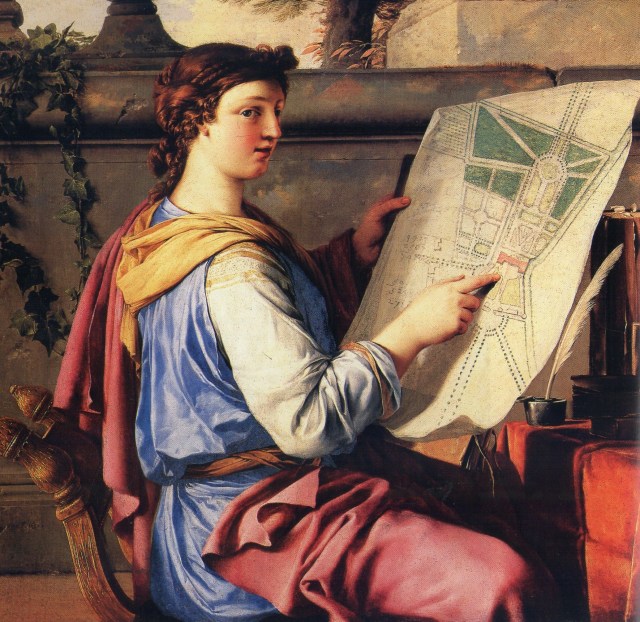
Allegory of Arithmetic (1650)
Oil on canvas 103 x 109 cm
Stichting Hannema-de Stuers Foundation, Heino, The Netherlands
To enlarge the picture, right-click on it and “Open in a new tab”
Laurent de La Hyre was a pupil of Jean Baptiste Lallemand, although the strongest influence in his formation was the work of the mannerists who worked in the decoration of the palace of Fontainebleau under the direction of the Italian Primaticcio. This influence is evident in his first works done during the 1630s, for example, Pope Nicholas V opening the Crypt of St. Francis of Assisi (Louvre). However, the figures already show a transition towards Italian realism. Although La Hyre never visited Italy he could admire and study the works of the Italian masters in the French royal collection, the result of such studies can be seen in Saint Peter Healing a Sick Man, 1635 (Louvre).
In 1639 he married the daughter of an important officer in the royal household of Louis XIII; at the death of his father-in-law, he inherited a fortune that allowed him to dedicate to his favourite genre, the mythological subjects and the landscapes in the manner of Poussin. In the late 1640s de La Hyre’s style evolved towards the academic classicism championed by Poussin and Philippe de Champaigne. In 1648 he became one of the founding members of the Royal Academy of Painting and Sculpture.
Between 1649 and 1650 Laurent de La Hyre made a series of seven paintings, each representing one of the liberal arts. These disciplines formed a body of knowledge which in ancient times was considered essential in life. They comprise Grammar, Rhetoric, Dialectic, Arithmetic, Geometry, Astronomy and Music.
The woman in the present picture represents Arithmetic. She is sitting at a table with books and a pen in front of her. She is pointing to a plan of a castle in a park-like setting. This, however, was a later addition painted over the original sheet with numbers and the words PAR IMPAR (Even-Uneven) Some of the numbers can still be seen through the overpainting. The idea was to transform the representation from Arithmetic into Architecture. The clean, sharp outlines of the composition show the influence of Philippe de Champaigne as well as the cool tonalities of the three colours employed in the figure’s dress. An excellent example of French classicism.
 Old Masters