
JEAN-MARTIAL FREDOU (1710-1795)
Portrait of Maria Josepha of Saxony, Dauphine of France (1760)
Oil on canvas 64 x 54 cm
Museum Boymans-van Beuningen, Rotterdam
To enlarge the image, right-click on it and “open in a new tab”
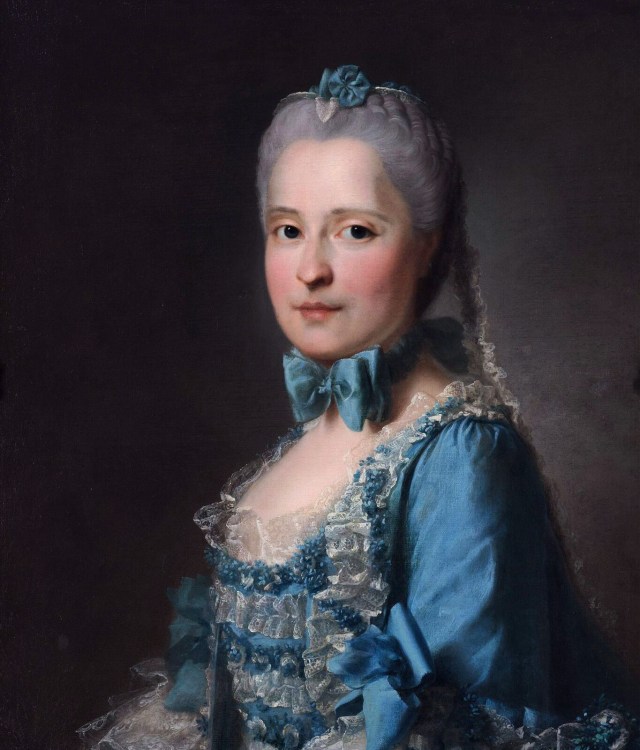
Unfortunately, we do not know who was creator of this beautiful portrait is, according to the records of the Boymans-van Beuningen Museum, this is a copy by Jean-Martial Frédou, a mediocre painter who was patronised by the Dauphin and his wife, Maria Josepha, and who worked mainly in pastels. Despite his shortcomings as a portraitist Frédou was, thanks to his thorough French academic training, a very competent copyist, therefore the real merit belongs to the brilliant artist who produced the original work of art.
From 1752 Frédou lived in the town of Versailles and, although he enjoyed the favour and patronage of the royal family; he was appointed Peintre du Cabinet du Roi in 1775 and in 1776 Premier Peintre de Monsieur, the eldest brother of Louis XV, he was not allowed a room in the palace. Despite a very long and fairly successful career of nearly 60 years Frédou´s work is little known. The French National Archives have preserved several invoices, presented in the form of memoranda, as well as inventories of commissions, which provide information about his work for the Court. His work for private clients, however, is poorly documented, mainly due to the loss in the 19th century of his diary, which listed all his works.
The duty of a Peintre du Cabinet du Roi (Painter to the King or Painter to the Royal household) was to produce copies of portraits of the royal family for French embassies, friends of the King and the Queen and important foreigners, usually ambassadors or high-ranking noblemen visiting France.
Most of his work around 1760 was for the Dauphin (the Crown Prince) and his wife, and this portrait of Maria Josepha of Saxony (1731-1767) was undoubtedly commissioned by the couple. The sitter was the daughter of the elector Frederick Augustus I of Saxony (1670-1733) who was also king of Poland under the title of Augustus II. In 1747 Maria Josepha married the Dauphin, the oldest son of Louis XV and Maria Leczynska. Their union produced three kings: Louis XVI, Louis XVIII and Charles X.
It is uncertain whether Maria Josepha actually posed for Frédou for this particular work, as the master based most of his portraits on earlier examples; as I mentioned before, his work as a member of the Cabinet des tableaux du Roi (Department of Paintings of the Royal Household) consisted mainly in producing copies after the finest painters of the day: Jean-Marc Nattier, Maurice Quentin de La Tour, Louis Michel van Loo and Alexander Roslin. In fact, if I had to name an artist as the most likely creator of the original it would be the Swedish master. The painting presents all the hallmarks of Roslin, sureness of touch, beautiful colouring, expressiveness and superb rendering of the fabrics and lace.
During my research for this post, I came across a beautiful oil painting based on a famous portrait by Maurice Quentin de La Tour. The inscription on the frame reads: “Donné par Madame la Dauphine a M. l´abbé de Murat son Aumonier” “Given by Madame the Dauphine to the abbot de Murat, her Chaplain”. This beautiful portrait was sold on June 29, 2022, by “Andrew Jones Auctions” in Los Angeles, California.
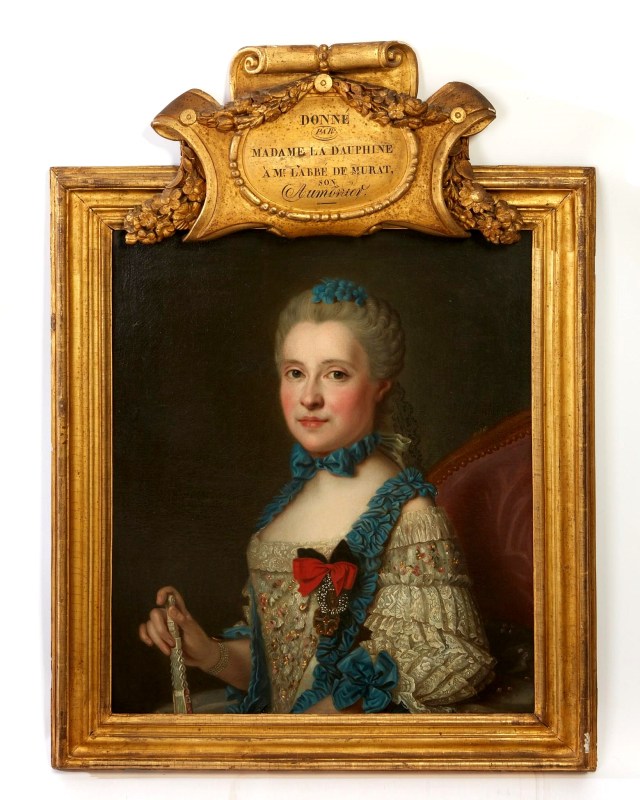
We do not know who the author of this beautiful portrait was, but I would say is an improvement on the pastel by de La Tour in the Louvre reproduced below.
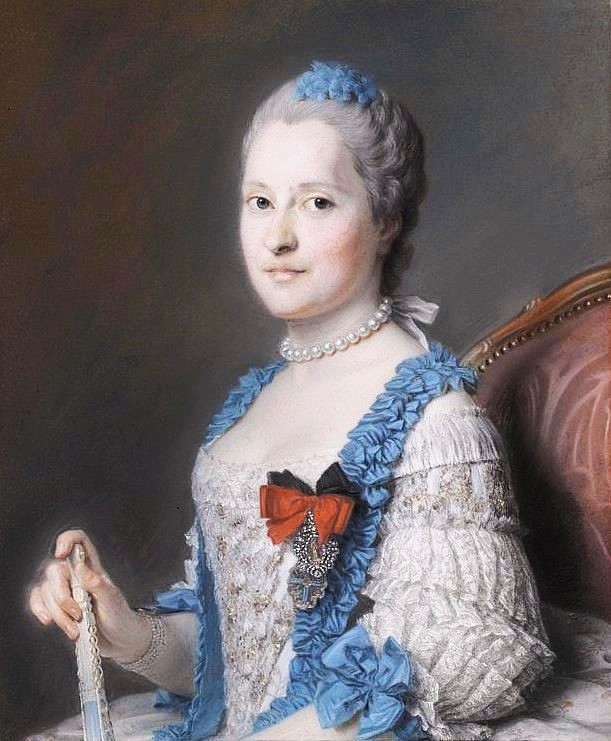
Strangely enough, the website of the Louvre Museum mentions the existence of an oil copy: “An oil-painted copy (0.66 × 0.55 m) was delivered to the Saxon court. Germain Bapst mentions it in 1883 (p. 124) as being by Anton Graff in the flat of the King of Saxony at Dresden Castle. The work is now listed in the inventory of the Gemäldegalerie Alte Meister in Dresden.” However, I searched the database of the Old Masters Gallery of Dresden and there is nothing about it, neither under the name of the sitter (Maria Josepha von Sachsen) nor the artist (Anton Graff). Could it be possible that the copy attributed to Anton Graff is the one which surfaced in the United States to be sold by Andrew Jones?
 Old Masters