
CLAUDE LORRAIN (1600-1682)
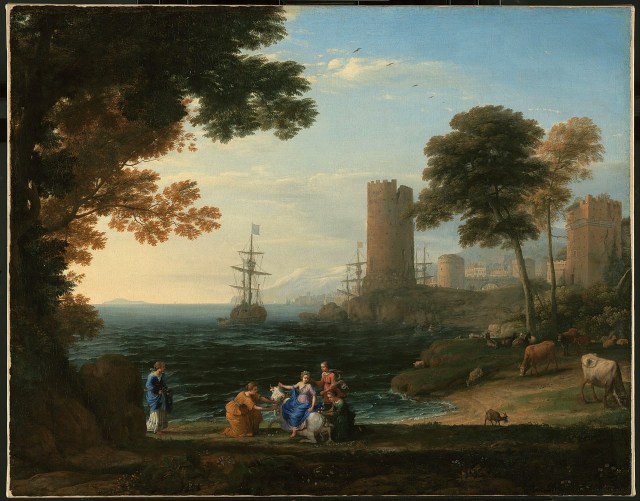
Landscape with the Abduction of Europa (1647)
Oil on canvas: 96 x 167 cm
Paul Getty Museum, Los Angeles, USA
To enlarge the picture, right-click on it and “Open in a new tab”
This painting is usually called “The Rape of Europa”; however, since the word rape in the English language has taken a particularly nasty connotation associated specifically with sexual violence, I believe the correct title in English should be “The Abduction of Europa”. Why? Because “rape” comes from the Latin verb rapere which means “seize, carry off by force, abduct”; in Classical Latin rapere was also used to describe “sexual assault” but only rarely; the usual Latin word for this kind of crime was violare “to defile, ravish, violate, treat with violence”. Latin languages (Spanish, Italian, French and Portuguese) remained faithful to their roots; that is why, the specific crime of sexual assault or violation in these languages is correctly described as violación (in Spanish), violation (in French) violazione (in Italian) and violação (in Portuguese). On the other hand, the action of “seize, carry off by force, abduct”, is described as rapimento (in Italian) rapto (in Spanish and Portuguese) and enlèvement (in French). All these words, with the exception of the French, clearly derive from rapere.
The abduction of Europe is one of the oldest Greek myths. According to the legend, Europa was a beautiful maiden, the daughter of Agenor the Phoenician king. Zeus fell in love with her and took the form of a white bull that mingled with the cattle of the king by the sea. Europa noticed the mighty bull and, as she got closer she was surprised by his docile, gentle nature. She decided to mount him, and as she did so Zeus swam across the sea with Europe on his back until he reached the coast of Crete, once there he revealed his identity and Europa became the queen of the island. She gave Zeus three sons, one of them the famous Minos, king of Crete.
Though The Abduction of Europa is not signed nor dated, there is no doubt that it was painted by Claude in 1647. Around 1635, having made a name for himself, he started to record his paintings in a portfolio of drawings to prevent forgeries. One of the sheets in his portfolio known as Liber Veritatis is a signed drawing after the painting; though likewise undated, it is among the works he produced in 1647.
On the reverse side of the drawing in the Liber Veritatis, Claude noted that he had made the painting for a client in Paris (tableau faicit pour Paris), the client’s identity, however, has never been established. The painting was first documented in 1771 as part of the collection of Sir Joshua Reynolds.
The Abduction of Europa follows the traditional manner of Claude: a historical or mythological scene takes place in a beautiful landscape bathed by a golden light. On the right we can see a fortified harbour, its mighty towers showing signs of decay; in the harbour, there are some ships, the fact that they are 17th-century ships and not ancient Greek vessels did not bother Claude who obviously was not worried about historical inaccuracies. The whole scene is illuminated from the left, and the elongated shadows tell us that is the evening
 Old Masters