
NICOLAS DE LARGILLIERE (1656-1746)
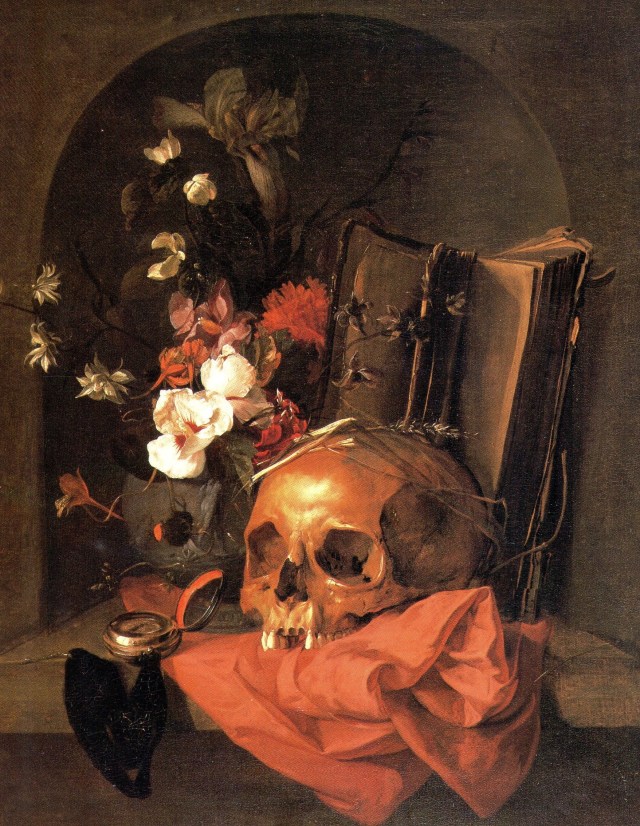
Vanitas (1677)
Oil on canvas 74 x 61 cm
Stichting Hannema-de Stuers Foundation, Heino, The Netherlands
To enlarge the picture, right-click on it and “Open in a new tab”
Nicolas de Largillière (or Largillierre) was born in Paris but his family moved to Antwerp in 1659. At an early age, he showed great aptitude for drawing and was apprenticed to a local artist, Antoine Goubau. He became a master of Antwerp’s Guild of Painters in 1674. A year later he was in London where his extraordinary skill attracted the attention of Sir Peter Lely who introduced him to King Charles II. He was given the task of restoring some paintings from the Royal collection which had been badly damaged during Cromwell´s dictatorship; he carried out the assignment in a manner that pleased the king greatly. He was invited to stay, but the growing hatred against the Catholics dissuaded him.
During his three-year stay in England Largillière painted portraits and still-lives; we know that he painted four of the latter, one of which is the present painting. It belongs to the genre known as Vanitas, a still-life that carries a religious message of moralizing nature. Basically, a vanitas is a memento mori, that is a reminder of our inevitable death. The idea is that all material possessions and intellectual achievements are mere trifles that should not detract us from leading a life according to Christian precepts. Luckily most Europeans did not believe in that nonsense; the product of an era known as the Dark Ages, when “the Faith” supported by ignorance, fear and superstition, reigned supreme.
The flowers are a symbol of inevitable decadence as is the skull, the watch symbolizes the inexorable passing of the years and the book is a reminder that intellectual achievements (according to fanatical Christians) are nothing to be proud of. The skilful composition, the subtle balance of colours and the beautiful chiaroscuro are all hallmarks of Largillière’s extraordinary qualities as a great master.
 Old Masters