
POMPEO BATONI (1708-1787)
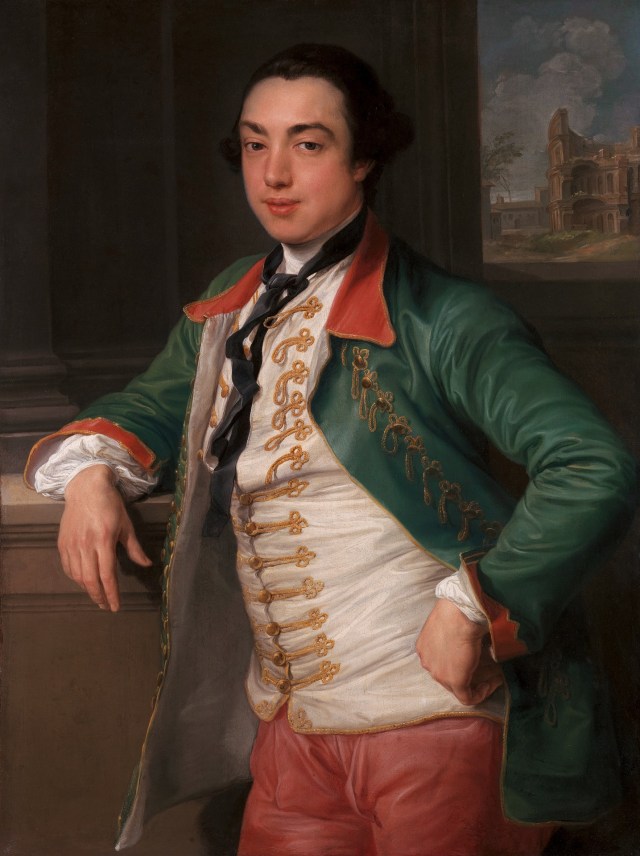
James Caulfeild, 4th Viscount Charlemont, later 1st Earl Charlemont (1753-56)
Oil on canvas (98 x 74 cm)
Yale Center for British Art, Yale, Connecticut, USA
To enlarge the picture, right-click on it and “Open in a new tab”
Pompeo Batoni was the portraitist of choice for the young British and Irish men on their Grand Tour in the second half of the XVIIIth century. In the 1740’s he had made his name primarily as a painter of historical and religious subjects, but his portraits catapulted him into the ranks of the most famous European artists of his time.
James Caulfield, born in Dublin in 1728, became 4th Viscount Charlemont at the death of his father in 1734. He left his home in Ireland for his Grand Tour, a voyage on the European continent that mainly consisted of a lengthy stay in Italy and had become a mandatory element in the education of a British gentleman. Charlemont’s Grand Tour was an extensive one; from 1746 until his return in 1755 he travelled throughout Italy and explored the major archaeological sites of classical Antiquity in Greece, the Levant and Egypt. When in Rome he met the famous archaeologist, artist and architect Giovanni Battista Piranesi (1720-1778) to whom he promised a large sum of money for the publication of his monumental work Le Antichitá Romane which was scheduled for 1756. For some mysterious reason that remains unexplained, Caulfeild did not provide the promised funds and Piranesi scratched his name from the dedication that appeared on the title-page of the first volume.
Batoni frequently painted variously sized versions of his portraits, which young Tourists often gave away as spectacular mementoes of their travels. In Charlemont’s case, there was a full-length portrait (lost) as we may gather from the correspondence between lord Charlemont and his agent John Parker:
26 July 1754: Pompeo has not finished nor can I get the portrait out of his hands, he is paid half for the great one. 28 February 1756: I have just got your Lordship’s two portraits from Pompeo. I shall forward them with the rest of the pictures.
Batoni’s formula for Grand Tour portraits was quite straightforward: most often dressed in their finest clothes, or in some of Batoni’s garments that served as props, Tourists were portrayed against vistas of recognizable sites of the Roman landscape and surrounded by famous antiquities, and, occasionally, by some of the works of art that they had purchased. In his portrait James Caulfeild is wearing what could be described as a “fancy dress” that became popular during the XVIIIth century thanks to the famous Venetian Carnival; men and women used to wear colourful and exotic garments. The Viscount is wearing a coat richly decorated with gold braid in the Hungarian style adopted later on by the European light cavalry regiments known as hussars (1)
Lord Charlemont returned to Dublin in 1754 and began a distinguished career as a politician, soon making a name for himself as one of the leading champions for Ireland’s peaceful emancipation from England. He was the first President of the Royal Irish Academy and a member of the Royal Dublin Society. He was made 1st Earl of Charlemont in 1763 and in 1783 he was made a founding Knight of the Order of St. Patrick. According to the Dictionary of Irish Biography: “Though his strong commitment to whig principles, and definite opinions on individuals as well as issues, have ensured that the verdicts of historians vary sharply, Charlemont impressed most who knew him by his loyalty to friends and firm conviction. His refined aesthetic sensibility and support for intellectual endeavour, which aided him to create a fine library as well as to become the first president of the Royal Irish Society in 1785, illustrate well his versatility.” https://www.dib.ie/biography/caulfeild-james-a1560
(1) According to The Webster´s Dictionary, the word hussar stems from the Hungarian huszár, which in turn originates from the medieval Serbian husar, meaning bandit. The flamboyant uniform of the Hungarian hussars was quickly adopted by all major European armies after the Seven Years War (1756-1763)
 Old Masters