
THOMAS GAINSBOROUGH (1727-1788)
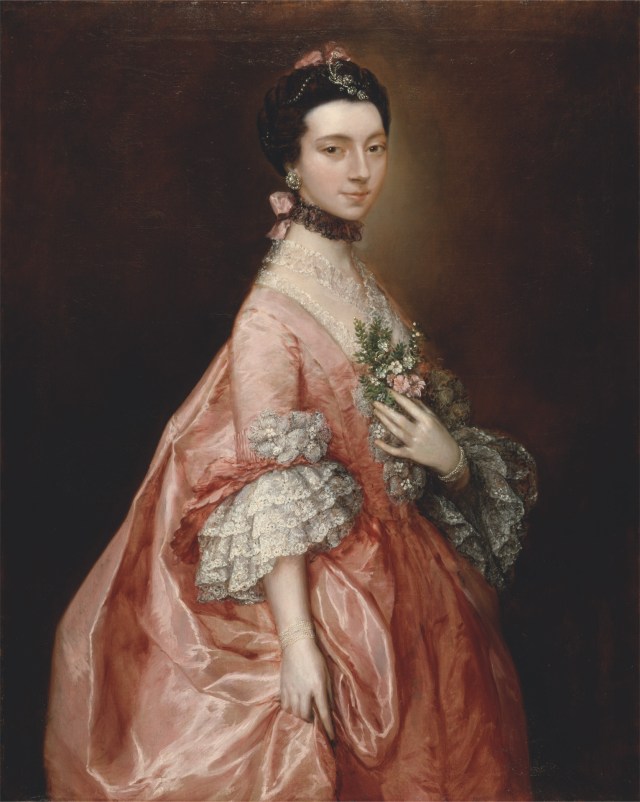
Mary Little, later Lady Carr (1763)
Oil on canvas (127 x 101 cm)
Yale Center for British Art, New Haven, Connecticut, USA
To enlarge the image, right-click on it and “Open in a new tab”
This painting may have been commissioned to celebrate the marriage of Mary Little to Robert Carr, who became a baronet in 1777 on the death of his brother. Mrs Carr displays her well-adjusted and adorned figure to advantage, and her portrait clearly takes inspiration from the images of XVIIth century beauties portrayed by van Dyck and Lely.
Like his predecessors, Gainsborough flatters the proportions and beauty of Mrs Carr by setting off her features with the various fabrics and textures of her attire. Her translucent white hands and face are indeed complemented by her dress and accessories: her black-lace ribbon necklace, the transparent lace-edged kerchief over her breast, the elaborate tiers of lace cuffs and bows, and the radiantly textured pink silk.
The artist gives life and depth to Mrs Carr’s flesh – particularly in her left hand, modelled with flecks of white and pink – and draws a pictorial analogy between her skin and the leaves and petals of the spring bouquet she holds at her breast. Unlike Reynolds – who painted his sitters unadorned by the trappings of contemporary clothing to emphasize the timeless qualities of their characters – Gainsborough revels in the description of Mary Carr’s stylish dress, a model that was popular in England during the 1760s. In France it was known as robe à l’Anglaise (robe/dress in the English manner). The main difference with the very popular robe à la Française (robe/dress in the French manner) was the absence of hoops in the former. The hoops made the skirt to stand out and drape in a stiff bell-like shape from the waist.
Her gown has voluminous pleated panels of fabric attached at the shoulder blades that fold down in a train over the back of her skirt. Her bodice is decorated with three-tiered lace ruffles and bows, and the flowers at her breast may even be held there in a small vase inserted into her bodice; this device was known as porte-bouquet in France and posy holder in England. The porte-bouquet could be attached to the bodice of the dress, to the chatelaine chain, or simply held in the hands. Her twin pearl bracelets match the larger pearls woven into her unpowered hair and in her pompon, a decorative hair ornament that moved and shimmered whenever the wearer moved her head. These details of her costume add what Gainsborough called “the variety of lively touches and surprizing Effects to make the Heart dance… (the) Lustre and finishing (that) bring it up to individual Life”(1)
Here the artist’s virtuoso rendering of the sumptuous fabrics of her dress are all the more appropriate since Mary Little’s future husband was a prosperous mercer.
(1) Mary Woodall (ed.) “Letters of Thomas Gainsborough” (1963)
 Old Masters