
SIR WILLIAM BEECHEY (1753-1839)
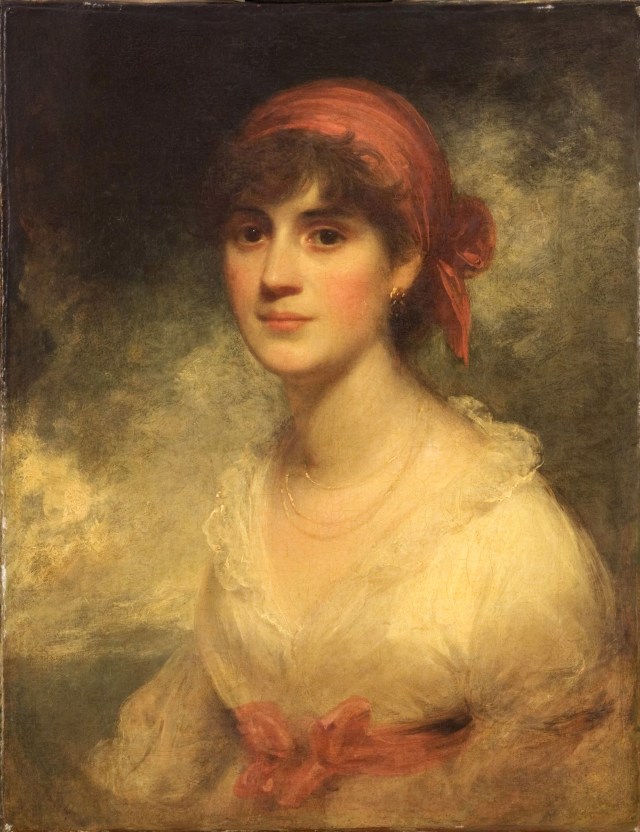
Elizabeth Eliot, Lady Le Despencer (1795-97)
Oil on canvas (63 x 48 cm)
Philadelphia Museum of Art, Philadelphia, USA
To enlarge the picture, right-click on it and “Open in a new tab”
Few artists of his generation probed more subtly the characters of their sitters than William Beechey. Born in Burford, Oxfordshire, Beechey was trained to the Law, entering a conveyancer’s office in Gloucestershire; however he soon quit his position there to work for a solicitor in London, it was there that he met some students of the Royal Academy and decided to join the Academy’s art school in 1772. His first patron was Dr. Strachey, a clergyman from Norwich who employed him to paint his family. Probably through Strachey, he received other Norwich commissions moving there in 1782 to set up a successful and fashionable practice. By 1787 he was back in London. Like Hoppner he may well have expected to succeed the blind Reynolds and the tired Romney, but like Hoppner his hopes were battered by the appearance of the young Thomas Lawrence. Nevertheless, his practice was a successful one and he gained the favour of Queen Charlotte becoming her principal painter. In 1798 “at the express intimation of the Queen,” he was knighted. He remained a popular artist and very well-liked by his colleagues, and in the 1830 election for the successor to Lawrence as President of the Royal Academy he received the second largest number of votes; he was beaten by Martin Archer Shee.
Elizabeth Eliot (1758-1848) married Thomas Stapelton, 22nd Baron Le Despencer (1766-1831) He inherited the barony in 1788 succeeding to vast estates in Kent, Oxfordshire, Yorkshire and Devonshire. He also owned large estates in the West Indies and many slaves, something for which we are supposed to be ashamed of and feel terribly guilty (as many moronic Englishmen do nowadays) while forgetting that it was England, and the Royal Navy, who put an end to slavery. By 1796 he was deeply in debt, hounded by his creditors. To keep Mereworth Castle (Maidstone, Kent) and his huge townhouse in Hanover Square, he sold large chunks of his lands, but he did not modify his lifestyle. By 1815 he was forced to flee the country living in Brussels.
The Philadelphia picture probably dates from the most flamboyant period of the couple’s married life, when the debts had not yet made inroads on their wealth. The sitter wears a simple white muslin dress with a red turban and a sash at her waist. These were the fashions in England in the 1790s and a comparison with the clothes and style of Beechey’s portraits of Charlotte, Princess Royal (Royal Collection) and Princess Augusta (Royal Collection) shows that our Lady Le Despencer should be dated around 1795-97. In all three pictures, the artist has set off a strongly focused and realistic face against a smokey and slightly hazy background; a beautiful example of Beechey’s elegant manner.
 Old Masters