
POMPEO BATONI (1708-1787)
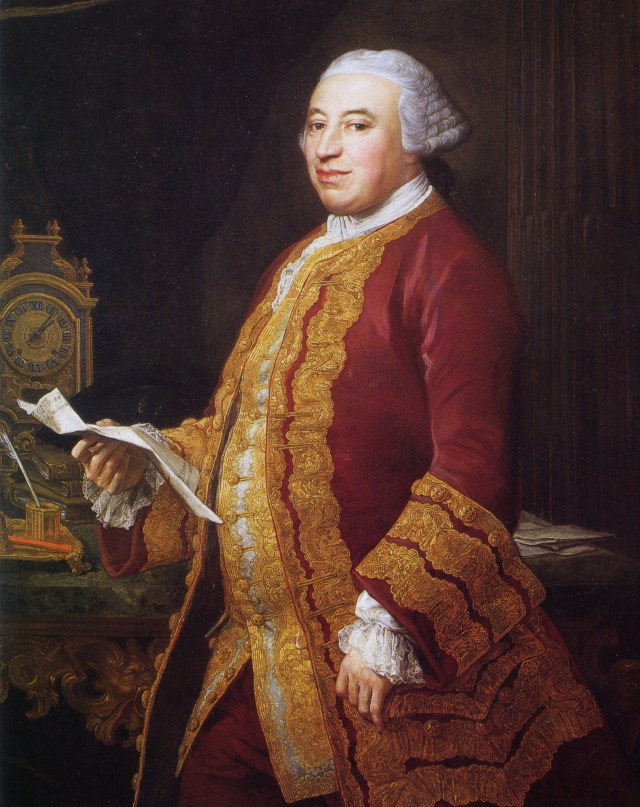
Portrait of the Count Niccolo Soderini (1765)
Oil on canvas (134 x 97 cm)
Galleria Nazionale d’ Arte Antica, Palazzo Barberini, Roma
To enlarge the image, right-click on it and “Open in a new tab”
Pompeo Batoni was born in Lucca, Tuscany, the son of a goldsmith. Trained by his father he showed at a very early age an exceptional aptitude as a draughtsman. In 1727 he moved to Rome to study under Sebastiano Conca and Francesco Imperiali. In 1732 he received his first commission, an altarpiece for the chapel of the di Gubbio family. By 1740 Batoni was a well-established painter famous for his elegant, restrained late Baroque classicism. His skill made him equally competent as a painter of altarpieces, mythological scenes and portraits. He became a highly fashionable painter, particularly after his rival, the neo-classical Anton Raphael Mengs, departed for Spain in 1761.
This superb portrait is proof that Batoni was not only a skilled draughtsman but also a master colourist; this is particularly evident in the delicate, subtle tones of the flesh. Another area of expertise was the rendering of luxurious fabrics and lace with that unique skill and flair that very few of his contemporaries could achieve, with the names of Roslin and Gainsborough coming to mind.
Count Soderini was the ambassador of the Grand Duchy of Tuscany to the Holy See, and therefore he was very active in the political intrigues that took place in Rome during the second half of the XVIIIth century. An Anglophile Soderini was the only Italian member of an exclusive Jacobite lodge and as such he worked for the re-establishment of the Stuart dynasty; one of the main goals of the Catholic Church’s foreign policy. He was on good terms with all the British visitors to Rome and that enabled him to obtain valuable information regarding the diplomatic aims of the British Crown. As strange as it may seem I could not obtain any extra information about the life of Count Niccolo Soderini, even the great Italian encyclopaedia Treccani failed to produce any information. I only know that, besides his diplomatic skill, he was a great art collector and that he died in 1779.
Batoni has depicted Niccolo Soderini in all his finery befitting a nobleman and a diplomatic of high rank. The intricate gold embroidery that decorates his waistcoat and coat is rendered with Batoni’s typical virtuosity; the pose is relaxed and yet dignified. Soderini looks at the spectator as if he has just been ushered into his studio; of particular interest is the clock shown by Batoni over the desk, it is 2.05 am, a detail that tells us that Soderini worked until very late into the night; or, at least, this is the idea that the painting strives to convey
 Old Masters