
CHRISTIAN SEYBOLD (1690-1768)
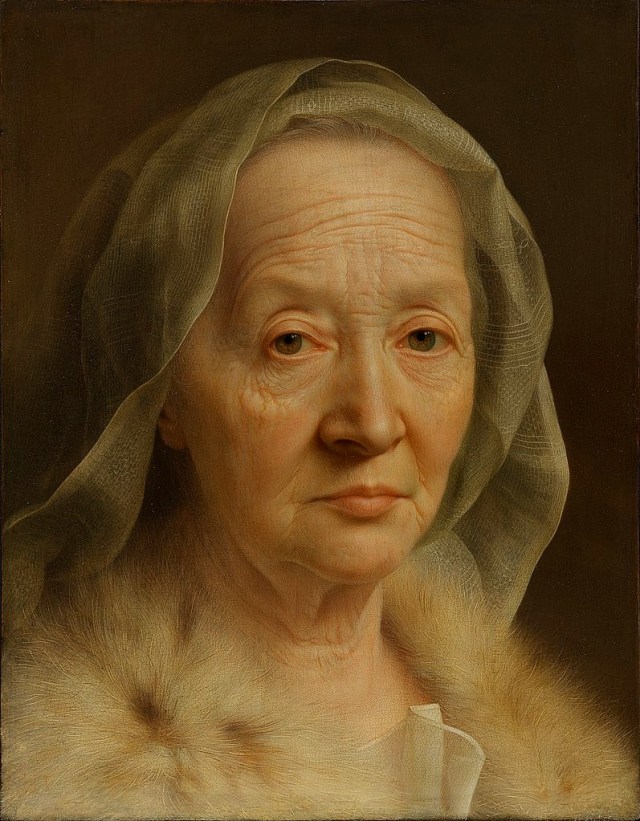
Portrait of an Old Woman, 1749-50
Oil on copper (37×29 cm)
Fogg Art Museum, Harvard University Art Museum, USA
To enlarge the picture, right-click on it and “Open in a new tab”
Until recently this painting had been attributed to Balthasar Denner (1685-1749), a highly successful and slightly older contemporary of Christian Seybold, who also painted similar illusionistic studies of elderly men and women. According to his biographer Nagler, Seybold trained as a self-taught painter. Later on he tried to imitate the highly-detailed style of his younger contemporary Balthasar Denner.
Seybold’s extraordinary skill in rendering details such as the sitter’s wrinkled skin and her soft fur collar shows clearly why he was a sought-after portrait painter. His predilection for such convincing renditions of textures also makes clear why he chose copper as the support for his modest scale portraits.
Seybold’s depiction reveals his penchant for hyper-realistic renditions. The woman’s placid gaze, focused on the viewer, reflects a peaceful soul. Deep wrinkles run across her forehead, around her eyes and at the corners of her mouth. Her skin sags below her eyes and puffs out slightly at her cheekbones.
Seybold seems to have been self-trained. In 1745 he was appointed by King August III of Saxony court painter, and four years later in 1749 he became Empress Maria Theresia’s court painter and associate memeber of the Imperial Academy of Fine Arts in Vienna. This portrait is very similar to one by Denner that was acquired by Emperor Karl VI in 1726; Seybold had access to the Imperial collection and surely was familiar with the works of Denner.
 Old Masters