
ANTON VON MARON
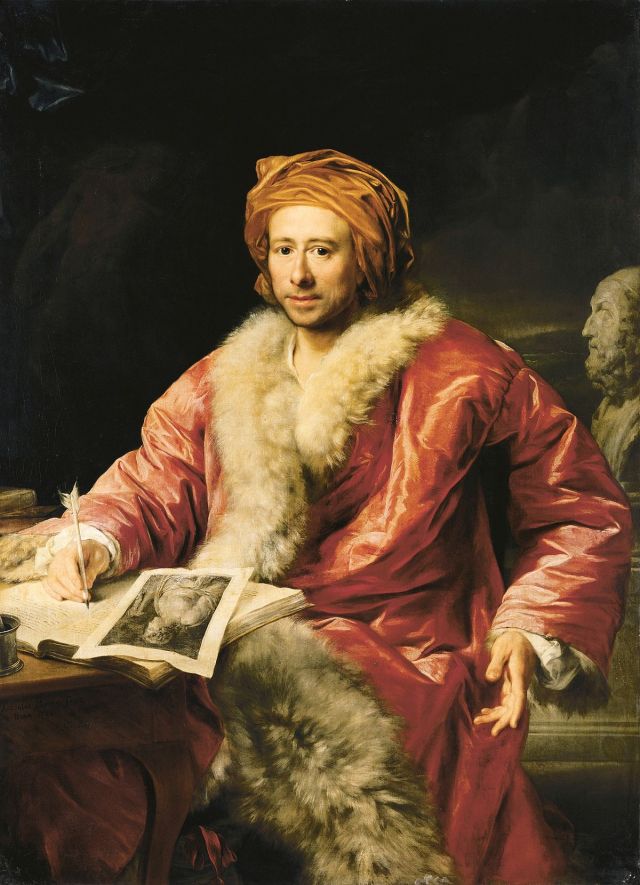
Portrait of Johann Winckelmann (1768)
Oil on canvas (136 x 100 cm)
Schlossmuseum, Weimar
To enlarge the picture, right-click on it and open it in a new tab
This is von Maron’s finest portrait, a work of art that truly deserves the title of a masterpiece. Painted a few months before Winckelmann’s tragic death, the picture shows the antiquarian and scholar sitting at his desk working on his last project, the Monumenti antichi inediti which, on the basis of intensive philological studies and the analysis and study of numerous documents created a new hermeneutical approach to the interpretation of ancient works of art. The project included the creation of 200 etchings illustrating monuments and statues; one of them, representing the reliefs of Antinoo in the collection of Cardinal Albani, is on Winckelmann’s desk. Behind the German scholar, there is a bust of Homer that represents not only one of Winckelmann’s most important sources, it also indicates that the scholar used classical Greek and Roman texts as sources for the identification of antique works of art
The sumptuous robe of red satin lined in wolf’s fur was Winckelmann’s choice as he discussed the progress of the painting in his letters to his friend Muzell-Stosch who commissioned the painting; he took a great deal of care about his appearance. It may also be that the robe was part of von Maron’s studio to be used as a prop, many important portrait painters kept clothes to be used in such a way; in fact, there is a portrait of John Rolle Walter (Christie’s 2007) by Pompeo Batoni where he wears a similar fur-lined robe in blue which appears again in the portrait of Henry Hutchinson O’Hara (Sotheby’s 2003)
Winckelmann, relaxed and yet dignified, seems to welcome the viewer to share with him the fruits of his labour, he represents an ideal of his time, the gentleman scholar at ease in his study surrounded by learned books, medals, coins and statues that reflect his intellectual pursuits. Von Maron’s virtuosity in rendering the fur and the shimmering satin of the robe, as well as the silk turban, shows him as an accomplished master of his craft. The warm, gentle expression on Winckelmann’s face shows also von Maron’s power to produce an excellent likeness by capturing the mood of his sitter.
 Old Masters