
JAN BRUEGHEL II (1601-1678)
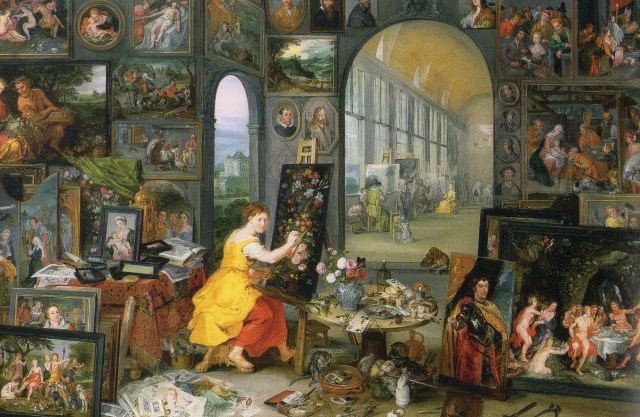
An Allegory of the Art of Painting (c. 1625)
Oil on copper 47 x 75 cm
Private collection, The Netherlands
Jan Brueghel II was an apprentice to his father. In 1622 Jan Brueghel II undertook a trip to Italy that abruptly ended in 1625 with the death of his father, and he returned to Antwerp to manage his father’s studio. The present painting is most probably from this period.
The picture shows a Muse painting a flower still-life using freshly cut flowers in a vase as a model. The room where she is working is filled with portraits and paintings of known and unknown Dutch, Italian and Flemish artists. In the background, there is a gallery of painters and students working on several paintings as well as assistants grinding pigments.
The painting belongs to the category of “gallery paintings”; this genre originated in the early years of the XVIIth century and its purpose was to illustrate the art collections of important connoisseurs and great noblemen; according to the documents available it was introduced by Frans Francken II (1581-1642).
In most gallery paintings with an artist present, often a Muse, the painting materials are mostly limited to some brushes, a palette and some pencils. In An Allegory of the Art of Painting, however, the accurate and ample representation of artistic materials are unique in their realism and richness of information. For example, on the left on the table and also on the floor we see many sketches and drawings on a white and coloured paper as well as prints, used as studies for future paintings.
On the floor, to the left, there is a box containing shells and pigments, folded paper containing powered pigments and a small drawing of various birds. A goose pen and presumably and ink pot are in the box. Next to it lies a feather used to wipe out charcoal drawings, a piece of cloth and some more shells with grounded pigments in them
The painting provides a glimpse into an important studio of the seventeenth century, with the apprentices at work and the assistants finishing paintings that the master has begun leaving to them the final touches. The assistants used to be paid for work and some received daily wages.
 Old Masters